Tag Archives: Music hall artistes

Bonny Kate Castleton

Kate Castleton

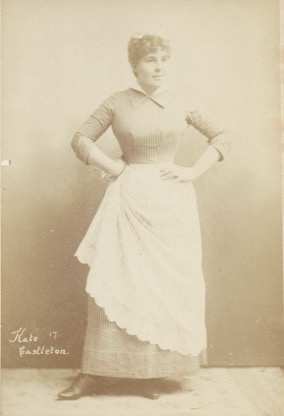
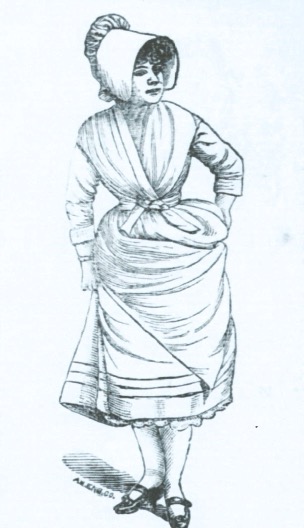
Kate Castleton was an early music hall performer and, as such, her formative years are difficult to trace. She was almost certainly born in 1856 in London and her last name was Freeman. There are varying accounts of her first name, the most common being Jennie, with Jane and May being other possibilities. Before she became a professional performer she said in a newspaper interview she worked in a factory making smoking-caps, was a member of a church choir and sang at temperance meetings. Information about this part of her life is hazy and the truth may have been given up for a story that would sit well with the public.
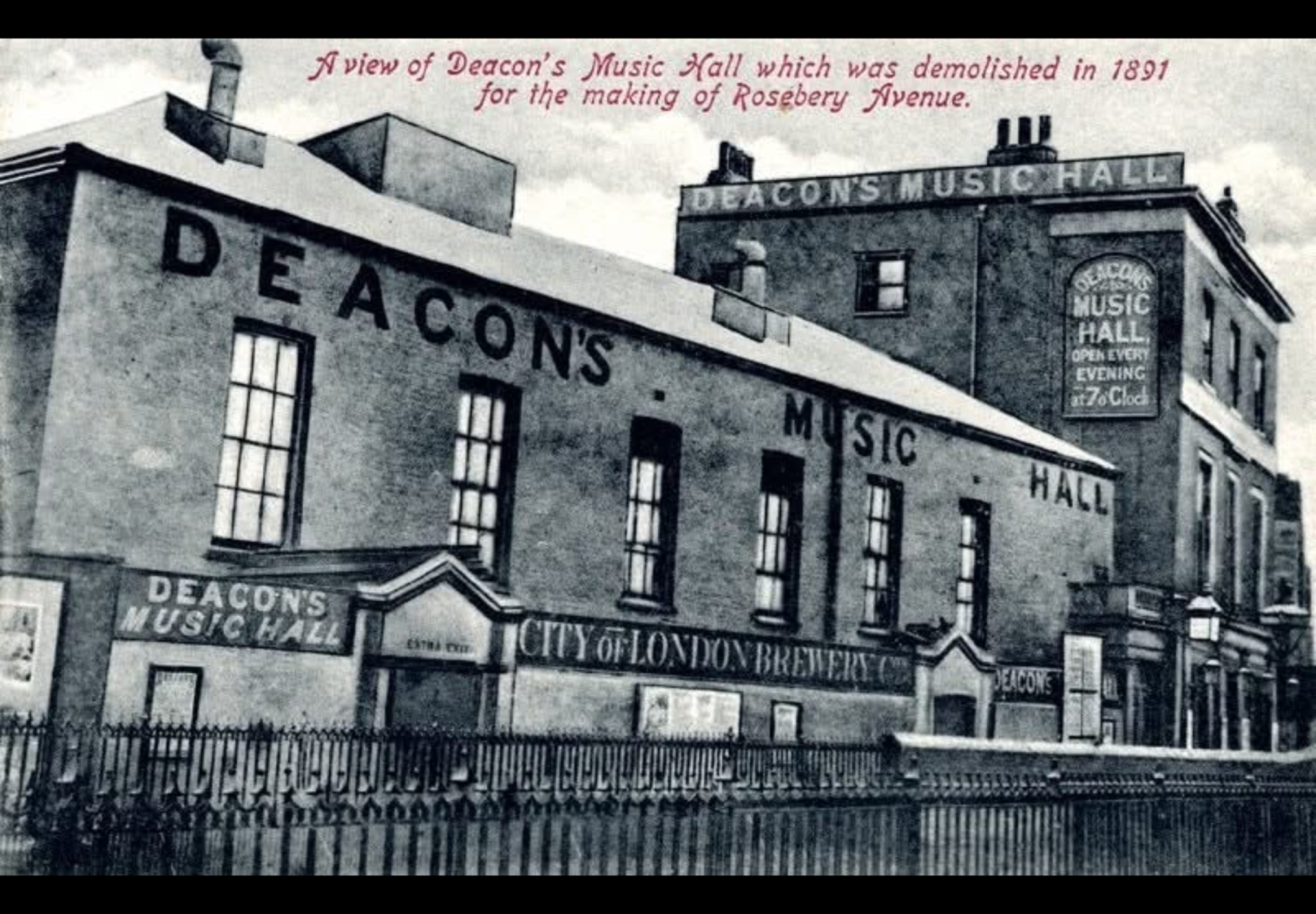


In 1875 there are accounts of her singing in the newly renovated Deacon’s Music Hall in Finsbury, London. She is described as a serio-comic with one rather patronising reviewer commenting, ‘in time, we should say that she will become popular.’ The trade paper, The Era, tells us Kate is nice-looking, wears good dresses and sings clearly and forcibly. She had been taken in hand by JW Cherry, a music teacher and composer of music hall songs. Mr Cherry was proud of his pupil and in 1876, during her Benefit at the London Alexandra Music Hall in the New Cut, he led her to the footlights where she was greeted with loud and protracted applause. The audience was known to be rowdy in that hall but her song Popsy-Wopsy found special favour and her dancing was said to be excellent. JW Cherry placed adverts in the trade papers offering tuition and boasted of Kate’s immense success everywhere.
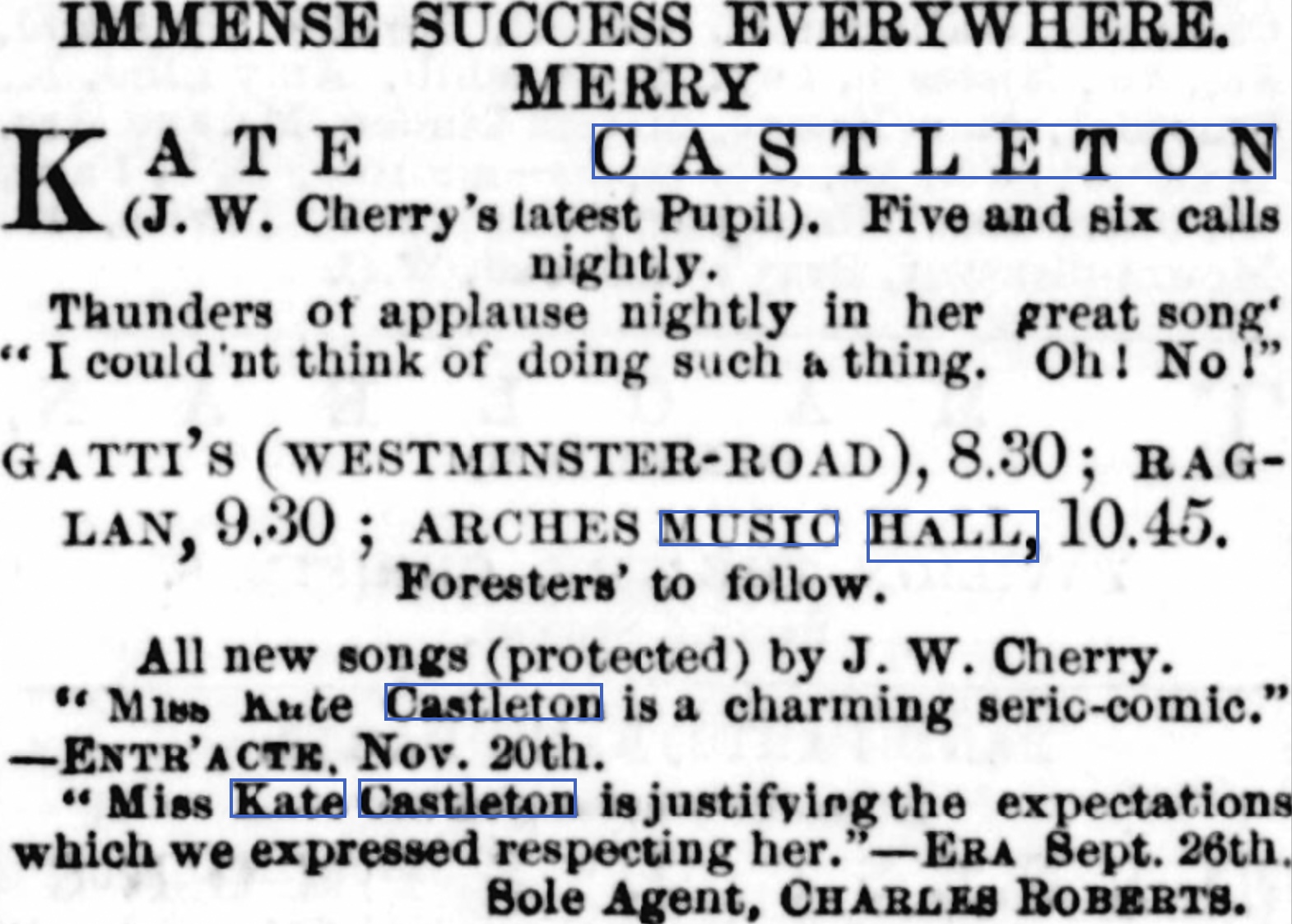
However, in 1876 Kate was offered work in the States by Josh Hart who ran the Eagle Theatre in New York. On September 2nd 1876 JW Cherry put an angry notice in the Enr’acte, a trade paper, ending all contracts with Kate Castleton and stating his intention to divide her songs among his other pupils, taking away her right to sing them. She had unfinished business with Cherry and had not re-signed her contract with him. She could no longer sing songs such as Come Along, h’Isabella containing the lyrics ‘Come along h’Isabella, H’under me h’umbrella.’
Screenshot


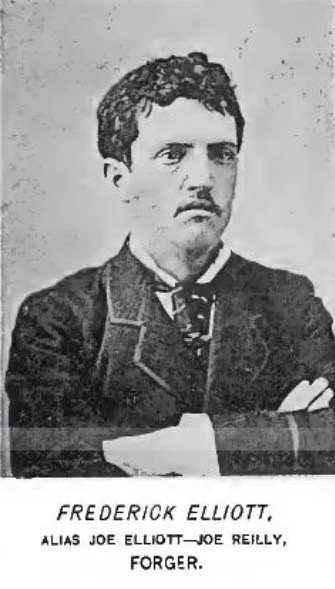
Kate started out at the Eagle Theatre and was a great success. One of her admirers was Joe Elliott, a forger, who had been in prison in more than one country and had a link with the murder of a fellow forger’s wife. She knew something of his criminal life but married him in the hope he would put it all behind him. The year after their marriage Elliott forged a draft for $64,000 on the New York Life Insurance Company. He was arrested but escaped and went to Boston where he stole $8,000 from a jeweller and was subsequently given a prison sentence of five years. Kate tried to secure his pardon but was unsuccessful. They lived together when Elliott came out of prison but soon divorced. They got back together and married again but in 1884 she was divorced again. Three days after getting this divorce she married Harry Phillips a theatrical manager. Phillips was her manager in the ‘musical plays’ she appeared in. In 1888 she was granted a divorce from Phillips on the grounds of his drunkenness and cruelty.

.
Kate had earned a good living in American theatre and bought two adjoining houses in Oakland, California in 1889. Her husband and some of his family lived in the larger house at the time of their divorce. They refused to leave and eventually Kate paid them to go – said to be $4,000. Kate’s family moved in, her sister occupying the smaller house, while Kate lived in a New York flat. In 1892 Kate died and various causes of death were given in newspaper obituaries. She was said to have died from a heart attack, peritonitis and death as the result of blood poisoning from a lotion used to treat sunburn. There is a strange addition to a report in an American newspaper reporting her death. It reads ‘Kate Castleton was never popular with professional people.’

Thanks to British Newspaper Archive, Ancestry, Monomania collection, Newspapers.com
From Theatre to Music Hall

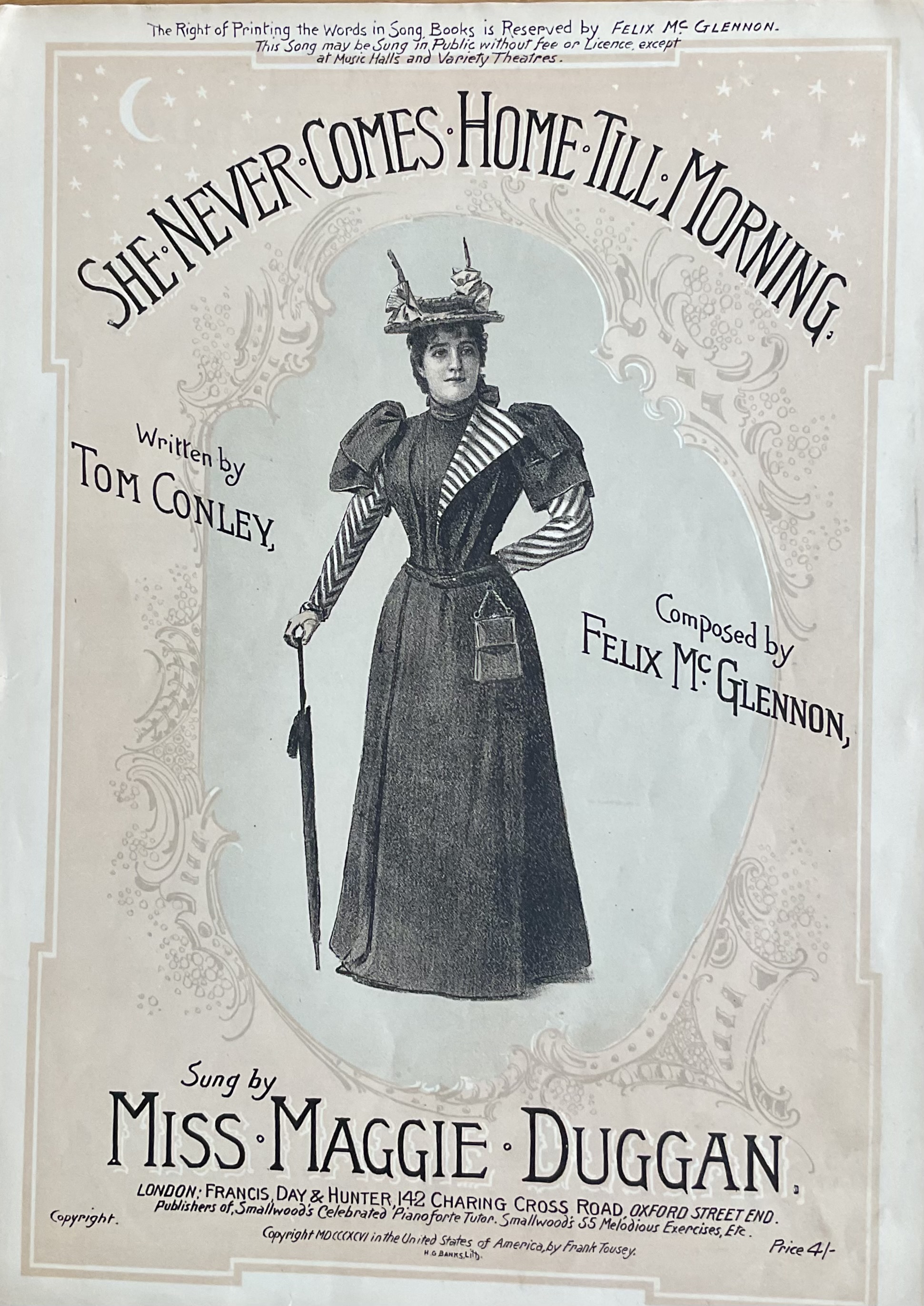
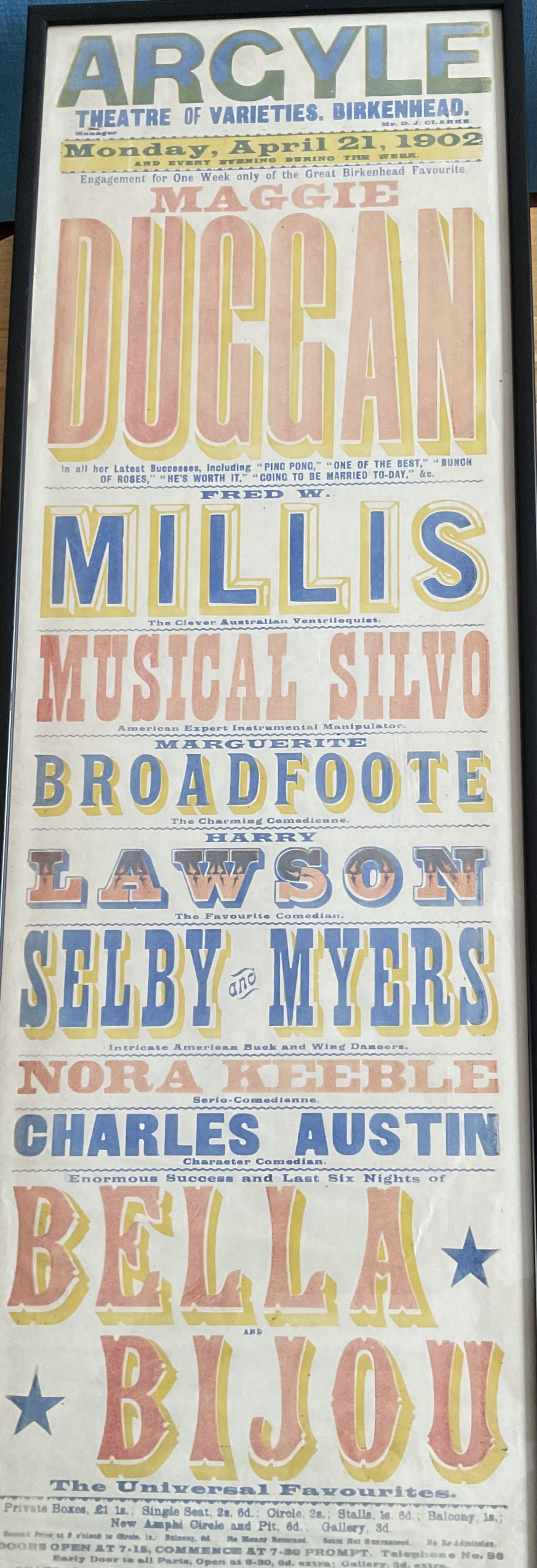
This is an amended version of my original post on Maggie Duggan as a reader has very kindly given me the correct information about her birth. She doesn’t have a birth record at the General Register Office in London, which was common amongst poorer families. She was born in Liverpool in 1857 and not 1860 as I had thought. The 1861 census shows her family living at 47 Blenheim Street in Liverpool. Her mother, Mary, is listed as the head of the household and as a sailor’s wife. Maggie was six months old and her sister, Sarah, was nine. Both Mary and Sarah have their place of birth listed as Ireland which could explain the later confusion over Maggie’s birthplace and accent when she was on the stage.

In an interview in the trade magazine, The Era, Maggie revealed she made her first appearance in a pantomime in her early childhood at the Adelphi Theatre, Liverpool. Her salary was three shillings a week and she was expected to provide her own boots. She disagreed with people who thought it wrong that children should act in pantomime saying ‘Tis very often delightful to the youngsters – – pantomime children are very often taken from poverty-stricken surroundings and taught the rudiments of an art that may bring them fame and fortune.’ The interviewer saw this as her opinion but it could have been her own experience.

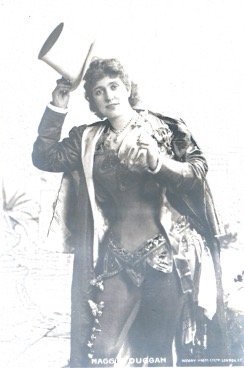
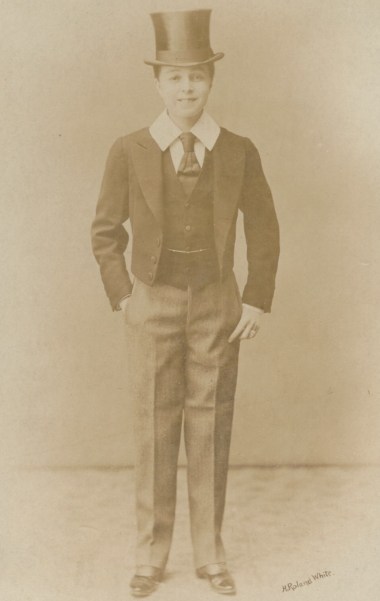
Maggie Duggan travelled as a member of a ballet troupe and then took the giant step of moving to the Cape as part of a theatre group. On arrival, she had trouble learning her lines and was so bad the manager declared he would send her home by the same boat that had brought her out. She persevered and added a hornpipe to her role which was so well received she stayed on and was at the Cape for two years. On her return to England she worked with burlesque and comic opera companies where she performed ‘breeches parts’ saying that she would feel dreadfully ill at ease in petticoats. The newspaper article is careful to add ‘that is, of course, on the stage.’ She thought a woman of her size looked ungainly in skirts on the stage.

There is a confusing remark from Maggie Duggan that the heroes of musical comedy were all played by men and, although she loved that kind of entertainment, she was looking for something different. Does this make sense after the breeches roles? Perhaps they were all burlesque. Maggie made a big splash with the Gaiety company in the second outing of the burlesque, Cinder-Ellen Up Too Late, taking the part of the Prince of Belgravia previously played by a man. During the performance she sang two music hall songs – The Man who Broke the Bank at Monte Carlo and The Rowdy-Dowdy Boys.The first of these had been plugged by Charles Coburn at The Oxford but when Maggie Duggan sang it Charles Coburn’s share of the royalties rose to £600. The other song was a music hall hit for Millie Hylton.

The popularity of these songs may have finally decided Maggie Duggan to switch to music hall, although it wasn’t always easy. She lamented the lack of good songs saying she could buy a hundred and just find one worth singing. In 1900 there is an advert in the Music Hall and Theatre Review placed by Maggie Duggan requesting good low comedy and character songs. She found the lack of rehearsal in music halls equally hard as the band could often be at cross purposes with the singer during a performance. Also, in her previous career she was better known on the provincial stage and worried it would be hard to get work in London halls.
This may have been unfounded as in 1894 we find in The Era that she moved from Birmingham to the London Alhambra and ‘other west end halls.’

Maggie Duggan excelled in pantomime with her height and build making for an excellent principal boy. She was in demand in Leeds, Manchester, Liverpool and, perhaps best for her career, Drury Lane. Ada Reeve in her autobiography, Take it For a Fact, talks about working with her in Little Boy Blue in 1893. Maggie Duggan played her role as principal boy ‘in the dashing, strutting manner peculiar to those days. Her trademark was a diamond butterfly which she wore pinned to her tights on her thigh.’

In June 1905 a headline in the London Morning Leader proclaimed in heavy type, Bigamy with Maggie Duggan. The court case was brought by Mrs Amy Ward against her husband, Thomas William Ward, and she asked for the dissolution of her marriage which had taken place in 1892. The couple separated in 1895 and Amy Ward alleged her husband was guilty of desertion, bigamy and misconduct. She had recently discovered her husband had entered into a bigamous marriage with Maggie Duggan. The petitioner had her watched when she was appearing at the Tivoli Music Hall, Manchester, and discovered that she and the respondent were living as man and wife. Mr Ward admitted the bigamous marriage but had been under the impression his wife was dead. Maggie Duggan was a widow when she married Mr Ward who had shown her a newspaper advertisement which she believed to be a notice of the death of his former wife. Mrs Ward obtained a degree nisi with costs.

Maggie Duggan died in 1919 in the Liverpool workhouse infirmary from bronchial pneumonia accelerated by alcohol. She was sixty years old and had retired from the stage some fifteen years earlier.

Thanks to The British Newspaper Archive, Monomania archive, Winkles and Champagne -Wilson Disher, Take it for a Fact -Ada Reeve

Many thanks to Raymond Crawford who took the trouble to read the post and contact me with the correct information.


.

A Good Night Out

Music hall audiences had a reputation for rowdiness, often well deserved, as they didn’t attempt to hold back their feelings about an artiste. However this was mild compared to theatre in the Georgian period when the gentry would invade the stage during a performance causing the actors the indignity of elbowing their way to the front to say their lines. Spitting, bottle and orange peel throwing and sword-fighting were also audience pursuits, while the singing of popular songs competed with the thespians speaking from the stage. There was a fashion for the wealthier patrons to use their footman to save a seat, which meant the servant could be sitting next to ‘a lady of the first quality’ – just not done.

In the earlier part of the nineteenth century Song and Supper rooms in public houses, known as Free and Easies, were a form of popular entertainment. Entry was free but the audience were expected, nay encouraged, to buy alcoholic drink. Originally only men were admitted and the entertainment came from within the audience with amateur singers strutting their stuff. A reporter tells us ‘the entertainment given at these pothouses are of a low order. Songs are badly sung, mumbled or bawled with an earsplitting accent.’ This didn’t put off the punters and gradually landlords added rooms for the entertainment nights which could be two or three times a week. The Free and Easies developed a reputation for drunkeness and bad behaviour. A letter to the Fleetwood Chronlcle in 1876 tells of the writer passing a Free and Easy in Blackpool ’out of which four boys were coming, and into which two were going; one of them was smoking a short pipe and the others were using profane language; the ages of these boys were from twelve and fourteen years.’ In the same year the chief constable of Preston described a Saturday night where five to six hundred young persons, half of them apparently under the age of sixteen, were to be found in a Free and Easy. Women and girls were now enjoying this kind of entertainment and young women would often take their babies. Groups of women, unaccompanied by men, were common with work-mates and neighbours meeting up for a good night out. The Manchester Evening News in 1877 reported the Chief Constable of that area proposed there should be Free and Easies without intoxicating drinks but which instead would sell cocoa. This seemed doomed to failure.

Wilton’s Music Hall 1859

As the popularity of this form of entertainment grew the halls increased in size and professional acts were engaged. In the early halls the audience sat around tables, some facing away from the stage, and food and drink were served by waiters. There was much coming and going and the performer, without the luxury of a microphone, would battle to be heard above the general hubbub. Gradually music halls were built as separate buildings with audiences sitting in rows on various levels with bars for the the purchase of drinks. The main bar of the Metropolitan, Edgware, had a wide glass panel through which the entertainment could be viewed. The top tier, the gallery, was usually the rowdiest with the ’gallery boys’ hurling rotten fruit and veg, dead cats and even iron rivets at the stage to show their displeasure. The orchestra pit was often covered in wire netting to protect the musicians. The music hall managers were constantly engaged in trying to make their halls respectable with licence renewal a major worry. A contract from the Parthenon Music Hall Liverpool, signed by Adelaide and Oswald Stoll, contains the rule ’Every artiste must stringently avoid introducing any obscene Song, Saying or Gesture’. They were up against such reformers as Mrs Ormiston Chant who saw the halls as dens of depravity with predatory prostitutes and crude performers from whom the lower classes needed protection.

Marie Lloyd

In 1909 the unfortunate Miss Charlesworth appeared at the Islington Hippodrome (later Collins), the Canterbury and the Paragon. On each occasion a gentleman introduced her and took a long time over it, to the displeasure of the audience. When Miss Charlesworth finally appeared she was greeted with a cacophany of boos and hisses and declared herself too nervous to to sing. She bowed to the audience before leaving the stage to the sound of sarcastic laughter. Fortunately this was not the experience of all music hall performers although their reception could vary from hall to hall. Marie Lloyd, much loved in London, was given an unenthusiastic reception in Bradford but gave as good as she got by not responding to an encore at the finish. TS Eliot noted that he had seen Nellie Wallace ’interrupted by jeering or hostile comment from a boxful of East-enders’ but he had never known Marie Lloyd to be confronted by hostility. He also notes that Nellie Wallace made a quick retort that silenced her hecklers.

Vesta Tilley
Ada Reeve

When postcards became the rage in the early 1900s music hall artistes were well represented and their fans collected the cards and sent them with messages of their everyday lives. In 1906 Mrs Baldwin hopes to see Vesta Tilley a week on Monday while a couple of years earlier Miss Gordon looked forward to seeing ’this Lady’ in all her latest successes. Ted saw Vesta Tilley at the Hippodrome (postmark blurred) and sends a card saying ’this girl was one of the soldiers who sang some songs.’ Ada Reeve is described as a nice girl – ‘not half’ by THH when writing to Miss Caley in 1905 and Florrie writes to Ethel to say she went to the Palace in Hull and bought the postcard of Gertie Gitana, ’the star artist.’ These audiences probably restrained themselves from throwing rotten food at the stage but showed their feelings nevertheless by joining in with chorus songs, wild applause and a bit of heckling. They had their favourites and sang and whistled their songs as they went about their business, secure in the feeling they had found a place where they belonged.

Thanks to the British Newspaper Archive, The Victorian Music Hall – Dagmar Kift

Marie Lloyd and Music Hall – Daniel Farson, Marie Lloyd – Richard Anthony Baker

The Popularity of Music Hall website

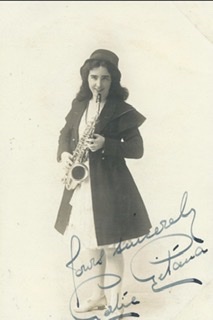
Gertie Gitana

Vaudeville’s happiest girl

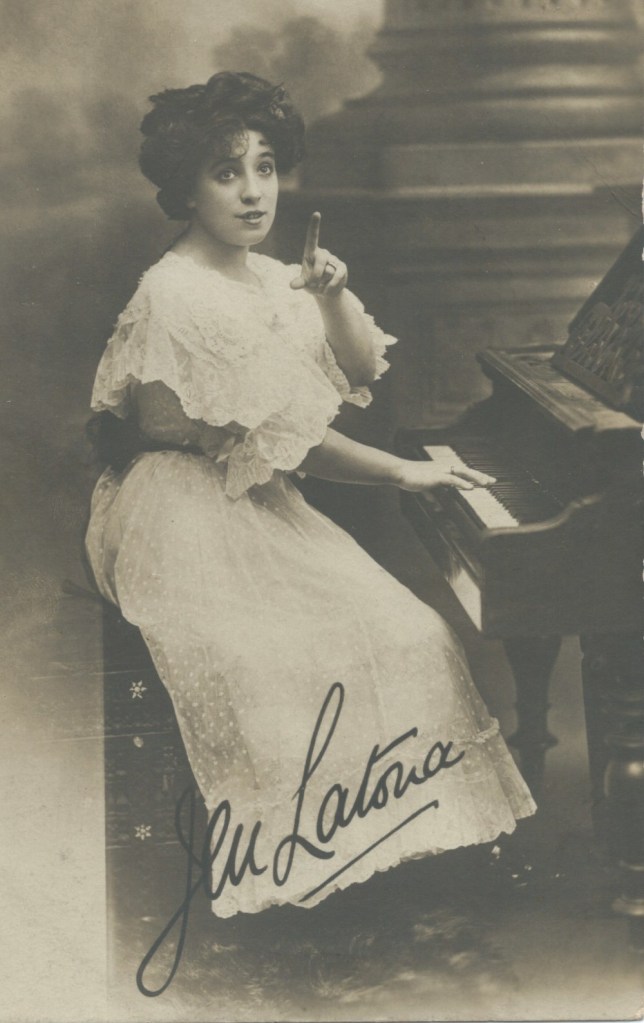
Jen Latona, real name Emma Jane Letty Carter, was born in 1881 in Birmingham. By the age of sixteen she was appearing in music halls under the name of Jennie Gabrielle. In January 1896 the Hull Daily Mail commented on her appearance at Hengler’s describing her as ‘the child musician, who possesses a singularly sweet and mellow soprano voice’. We learn from a review of her performance at the Palace Theatre in Edinburgh that she sang humorous songs and accompanied herself on the piano and concertina.

Jennie married an American performer twenty-five years her senior, born Benjamin Franklyn Titus, whose stage name was Frank Latona. Jennie Gabrielle became Jen Latona. Frank performed as a tramp musician, playing the trombone and a one-stringed fiddle, and included various effects in his act which he constucted himself. In a handwritten pencil note on a scrap of paper Frank reminds himself to ‘make whiskers to blow out and curl up – air pumps and rubber tube’.

Frank Latona

Jen and Frank worked together as a double act with music, song, gags and repartee. In the archive of their work, presented to the Mayor of Lambeth by Jen Latona in her retirement, can be found handwritten sheets of ‘gags’, while jokes were often constructed from cut out newspaper articles. A handwritten notebook of sketches and gags contains this gem – ‘Why, that is the meanest man you ever saw. He is so mean he goes to the track and makes faces at the engineers so they will throw coal at him’. Newspaper personal ads were fair game too, with ‘Two girls want washing’ setting the standard. The couple performed extensively in New Zealand and the United States scribbling down material for their act on hotel notepaper and receiving offers of new songs from American songwriters.

Margaret Cooper

When Frank Latona retired, Jen became a successful solo performer. She was on the bill with Vesta Tilley at the opening of the Croydon Hippodrome and was described as an ‘entertainer of exceptional merit’ to be compared with Margaret Cooper, a classically trained pianist who moved over to the music hall. However the writer quickly explains that Miss Cooper’s songs are of quite a different nature but that Jen is ‘a turn quite above the ordinary found at the halls’. Jen composed much of her stage music and the sheet music of the day shows she had a prolific repertoire with such songs as I’m going to buy you the R.I.N.G. and You can’t blame a Suffragette for that.

Frank died in 1930 and Jen retired a few years later. She lived in Streatham in London and when she died in 1955 her home and possessions were put up for auction, including a Schrieber grand piano and a souvenir programme of Sarah Bernhardt at the London Coliseum in 1913. The proceeds of the sale went to the Variety Artists Benevolent Fund.

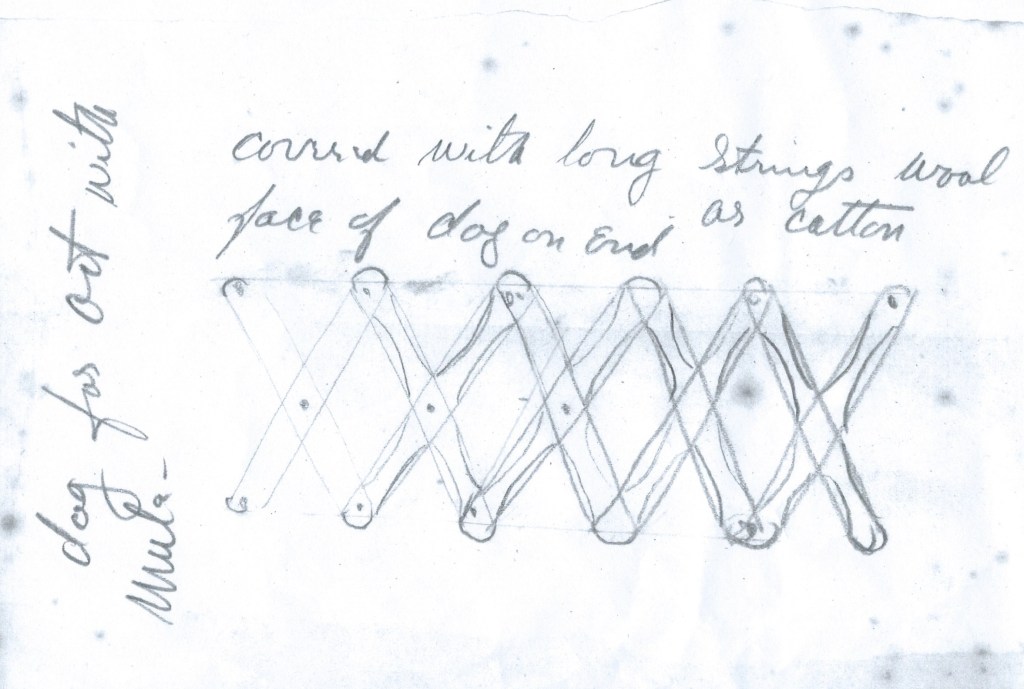
Frank had a genius for mechanical invention and invented and patented the Ednor Tank Washer. Of more interest to music hall fans here is a drawing in Frank’s hand of the workings of a dog to be used in an act with a mule.

We’ll leave the Latona’s with a final joke. ‘You are the most ignorant man I ever saw. Why, only yesterday I saw you giving hot water to the hens to make them lay hard-boiled eggs’. I hope you hear the echo of laughter.

Thanks to the British Newspaper Archive and Lambeth Archives. Images Monomania.

Behind the scenes

image

Waiting to go on at the Royal Music Hall

Music hall life was often far from the glamour and glitter we might imagine as this description of a dressing room by singer Lilian Warren shows. She is being interviewed for the trade Paper The Era in 1905 and remembers how artistes would apply their make-up by a ‘small piece of candle’ and a mirror which they supplied themselves. She tells of a music hall in Aberdare where thirteen performers shared one dressing-room where they clubbed together to make the room more acceptable. Lilian bought coal for the fire and the other girls provided the candles. By the time of her interview there had been a marked change with more comfortable, clean dressing-rooms provided.


Jenny Hill

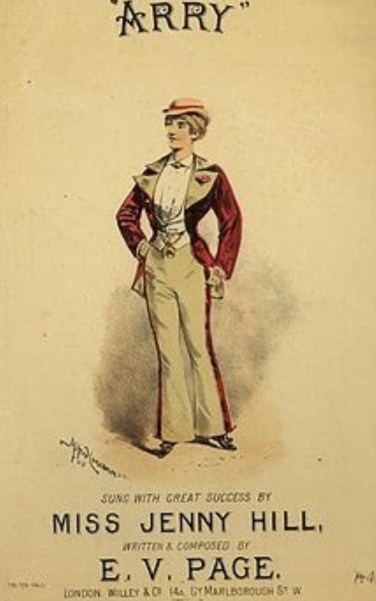
Jenny Hill, ‘The Vital Spark’ became a successful and respected serio-comic but started life in poverty. At a young age she was articled for five years to the Bradford Tavern and her life was not her own. She started work cleaning the bars at a very early hour and then was expected to be changed and in the singing room by mid-day  to harmonise with the drinkers. She often worked until 2am and food was scarce. Jenny died in her late forties and her early life took a great toll.


8BA73A3D-4599-4B56-B59B-449637043563

Marie Lloyd

Marie Lloyd was known as being kind-hearted and was well aware of class distinction and the poverty of the working classes. One day she was leaving a music hall at the end of a performance when she found a group of children round the stage door. They had no shoes and generous Marie took them to a local shop and bought them boots. The next day they were at the stage door again but with no boots. This was recounted by another performer who was with Marie Lloyd at the time.

38655E50-E0D6-4931-9413-BA683B57E230

Vesta Tilley


Vesta Tilley encountered a different kind of behind the scenes experience when performing at a dinner for ‘the poor of London’ given by the King. She arrived at a large building in the city wearing her Eton schoolboy costume and found there were several rooms being used for the dinner. She was running up and down the stairs trying to find the right room passing various officials on the way. Vesta heard one of them indignantly comment that the problems were not helped by these boys getting in everyone’s way.


In her autobiography Vesta Tilley remarks on the rivalry that could exist between performers amid the desire to be top of the bill. There could be appropriation of a successful artiste’s songs or of part of their act and music hall managers were often unsympathetic as they could pay the imitator less money. Vesta felt that in some cases the audience wanted a particular song rather than a particular singer. She mentioned the case of mimics such as Cissie Loftus who was acknowledged as an excellent performer but would have songs lifted from her act by others who made little attempt to portray their subject in a way that was recognisable to the audience.

C62D0D76-95B2-4C49-AF61-02FB6E5D2F9F

Cissie Loftus


Music hall performers had their highs and lows on and off the stage but they understood their audiences and their audiences loved them for it.


Thanks to the British Newspaper Archive, Recollections of Vesta Tilley, The Early Doors – Harold Scott


The Music Hall Strike

The previous post talked about the harsh contracts imposed on music hall performers by managers and owners of the halls. This hit those lower down the bill particularly hard as their pay wasn’t great and they had previously relied on playing more than one hall a night to make a living. The Variety Artistes Federation was formed in February 1906 and was a union of music hall entertainers created to represent them in negotiations with owners and managers. There was a long running dispute over matinée performances which were inserted into the programme with payment for one matinée regarded as covering five matinees if the manager chose. This was true for performers, musicians and stagehands. The Trade Disputes Act later in the same year meant that the right to strike was enshrined in law in the event of a trade dispute with an employer.

image

Oxford Music Hall

In 1907 there was a strike of performers, musicians and stagehands bringing together the members of three unions. Many London music halls were affected with picket lines, including well-known stars, dissuading the public from entering. Managers reduced prices and put on new and untried acts which played to small audiences who often left part way through. The Daily News reports that the new programme at the Canterbury Music Hall, Lambeth, was abandoned as the trainers couldn’t get a troupe of performing elephants to leave the stage. At other halls such as the Oxford the manager appeared on the stage to explain the situation and for the most part the audience were given their admission money back.

image

Marie Dainton

Some encouragement was given to popular artistes to break the strike with Marie Dainton, actress and mimic, being offered the carrot of a future engagement at the Holborn Empire and a motor-cab to make her journey easier. She replied ‘I can only be led by the Variety Artistes Federation.’ This performer is often credited with being a leading figure in the strike but in a letter to the London Daily News she writes ‘ I do not wish to be exploited as taking a prominent part in the strike—as statements have been made in one or two papers that make it appear as though I was taking special steps in the matter.‘ A week later the Daily News received another letter from Marie Dainton saying that although she would not accept engagements at the affected halls she was resigning from the Federation. She concludes ‘I have the greatest respect for the artistes of the music hall profession, but I refuse to be identified with the scene-shifters or stage employees.’

Some of the higher earning stars did not support the strike but Marie Lloyd was a enthusiastic spokesperson stating that ‘We can dictate our own terms. We are not fighting for ourselves, but for the poorer members of the profession, earning thirty shillings to three pounds a week. For this they have to do double turns, and now matinées have been added as well. These poor things have been compelled to submit to unfair terms of employment, and I mean to back up the Federation in whatever steps are taken.’ She was a regular on the picket line and when the unfortunate Belle Elmore crossed the line to perform Marie urged her companions not to stop her, saying she was such a bad performer she would empty the hall anyway.

Marie Lloyd 2

Marie Lloyd

Some performers took advantage of the situation by appearing in the affected halls but it didn’t always turn out well for them. Evelyn Taylor was reported as appearing at eight of the picketed halls each night but found she was unable to find a cab to take her between halls. The drivers refused the job. The London Tram, Bus and Motor Workers Union resolved to support the strike in any way possible. The official artistes association in America, the White Rats, cabled that they were with the strikers ‘heart and soul’ and would do everything possible to help the cause. Financial support came from individuals and provincial branches of the Alliance and from a levy on the salaries of working members of the Alliance. There was a surge of performers calling to be enrolled as members of the Federation with two hundred names being taken before two o’clock on one day. Most of these had refused engagements in the affected halls. The Federation increased it’s membership to around five thousand.

It came to be known as the music hall war and we’ll continue next time.