Tag Archives: Music Hall

From Theatre to Music Hall

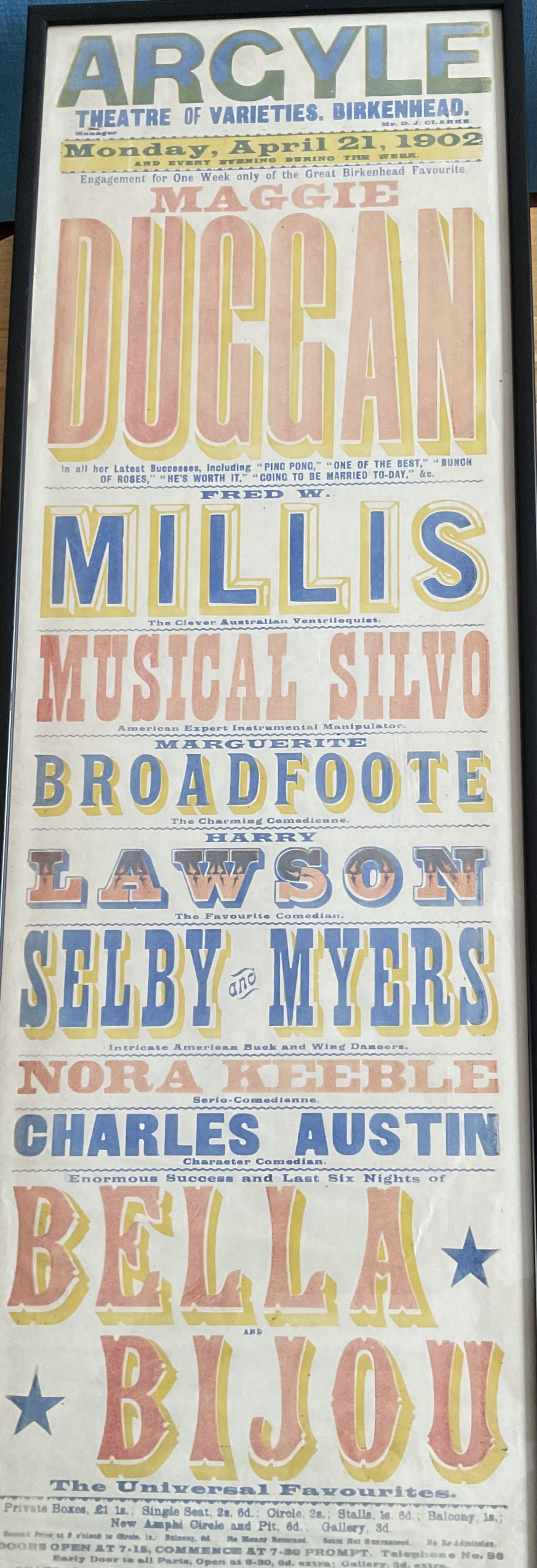
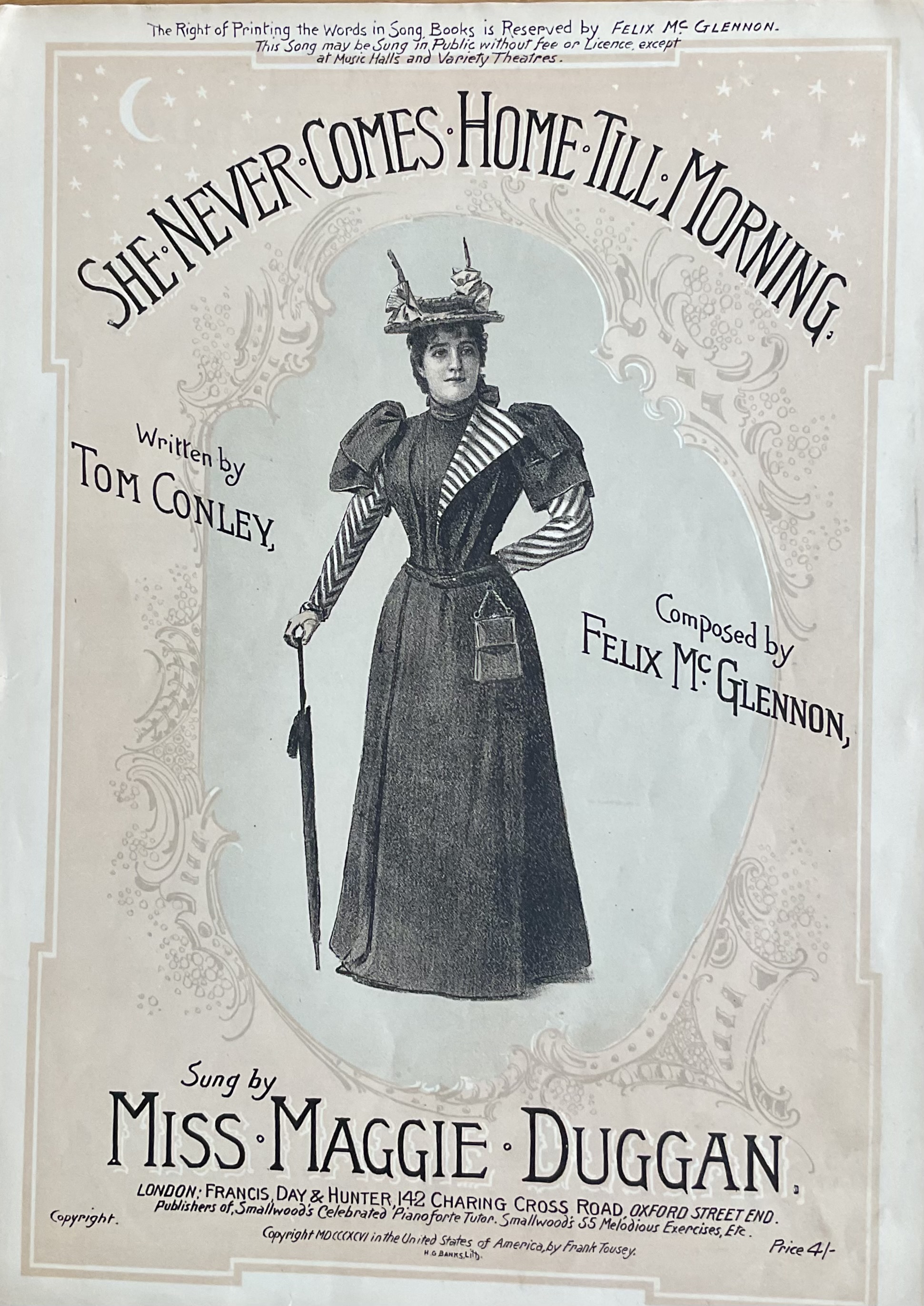
This is an amended version of my original post on Maggie Duggan as a reader has very kindly given me the correct information about her birth. She doesn’t have a birth record at the General Register Office in London, which was common amongst poorer families. She was born in Liverpool in 1857 and not 1860 as I had thought. The 1861 census shows her family living at 47 Blenheim Street in Liverpool. Her mother, Mary, is listed as the head of the household and as a sailor’s wife. Maggie was six months old and her sister, Sarah, was nine. Both Mary and Sarah have their place of birth listed as Ireland which could explain the later confusion over Maggie’s birthplace and accent when she was on the stage.

In an interview in the trade magazine, The Era, Maggie revealed she made her first appearance in a pantomime in her early childhood at the Adelphi Theatre, Liverpool. Her salary was three shillings a week and she was expected to provide her own boots. She disagreed with people who thought it wrong that children should act in pantomime saying ‘Tis very often delightful to the youngsters – – pantomime children are very often taken from poverty-stricken surroundings and taught the rudiments of an art that may bring them fame and fortune.’ The interviewer saw this as her opinion but it could have been her own experience.

Maggie Duggan travelled as a member of a ballet troupe and then took the giant step of moving to the Cape as part of a theatre group. On arrival, she had trouble learning her lines and was so bad the manager declared he would send her home by the same boat that had brought her out. She persevered and added a hornpipe to her role which was so well received she stayed on and was at the Cape for two years. On her return to England she worked with burlesque and comic opera companies where she performed ‘breeches parts’ saying that she would feel dreadfully ill at ease in petticoats. The newspaper article is careful to add ‘that is, of course, on the stage.’ She thought a woman of her size looked ungainly in skirts on the stage.

There is a confusing remark from Maggie Duggan that the heroes of musical comedy were all played by men and, although she loved that kind of entertainment, she was looking for something different. Does this make sense after the breeches roles? Perhaps they were all burlesque. Maggie made a big splash with the Gaiety company in the second outing of the burlesque, Cinder-Ellen Up Too Late, taking the part of the Prince of Belgravia previously played by a man. During the performance she sang two music hall songs – The Man who Broke the Bank at Monte Carlo and The Rowdy-Dowdy Boys.The first of these had been plugged by Charles Coburn at The Oxford but when Maggie Duggan sang it Charles Coburn’s share of the royalties rose to £600. The other song was a music hall hit for Millie Hylton.

The popularity of these songs may have finally decided Maggie Duggan to switch to music hall, although it wasn’t always easy. She lamented the lack of good songs saying she could buy a hundred and just find one worth singing. In 1900 there is an advert in the Music Hall and Theatre Review placed by Maggie Duggan requesting good low comedy and character songs. She found the lack of rehearsal in music halls equally hard as the band could often be at cross purposes with the singer during a performance. Also, in her previous career she was better known on the provincial stage and worried it would be hard to get work in London halls.
This may have been unfounded as in 1894 we find in The Era that she moved from Birmingham to the London Alhambra and ‘other west end halls.’

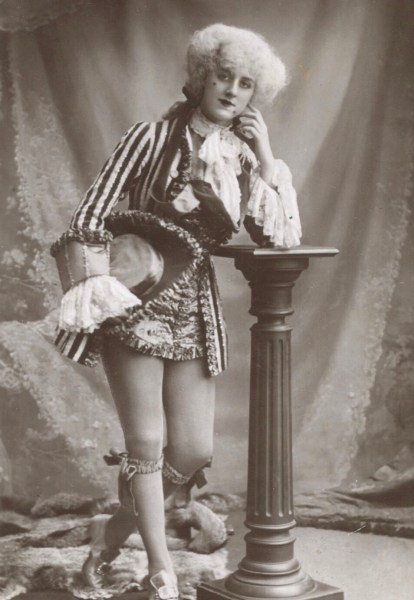
Maggie Duggan excelled in pantomime with her height and build making for an excellent principal boy. She was in demand in Leeds, Manchester, Liverpool and, perhaps best for her career, Drury Lane. Ada Reeve in her autobiography, Take it For a Fact, talks about working with her in Little Boy Blue in 1893. Maggie Duggan played her role as principal boy ‘in the dashing, strutting manner peculiar to those days. Her trademark was a diamond butterfly which she wore pinned to her tights on her thigh.’

In June 1905 a headline in the London Morning Leader proclaimed in heavy type, Bigamy with Maggie Duggan. The court case was brought by Mrs Amy Ward against her husband, Thomas William Ward, and she asked for the dissolution of her marriage which had taken place in 1892. The couple separated in 1895 and Amy Ward alleged her husband was guilty of desertion, bigamy and misconduct. She had recently discovered her husband had entered into a bigamous marriage with Maggie Duggan. The petitioner had her watched when she was appearing at the Tivoli Music Hall, Manchester, and discovered that she and the respondent were living as man and wife. Mr Ward admitted the bigamous marriage but had been under the impression his wife was dead. Maggie Duggan was a widow when she married Mr Ward who had shown her a newspaper advertisement which she believed to be a notice of the death of his former wife. Mrs Ward obtained a degree nisi with costs.

Maggie Duggan died in 1919 in the Liverpool workhouse infirmary from bronchial pneumonia accelerated by alcohol. She was sixty years old and had retired from the stage some fifteen years earlier.

Thanks to The British Newspaper Archive, Monomania archive, Winkles and Champagne -Wilson Disher, Take it for a Fact -Ada Reeve

Many thanks to Raymond Crawford who took the trouble to read the post and contact me with the correct information.


.

Slumming it!

If you saw yourself as a respectable person in 1851 you did not frequent the ‘Penny Gaff’ as described by Henry Mayhew in London Labour and the London Poor. It was a place of entertainment considered to be coarse and vulgar, which led to low morals in the young. The visitors, with few exceptions, were all boys and girls, whose ages seemed to vary from eight to twenty years. Some of the girls – though their figures showed them to be mere children – were dressed in showy cotton-velvet polkas, and wore dowdy feathers in their crushed bonnets. – – Some of them chose their partners and commenced dancing grotesquely, to the admiration of the lookers-on, who expressed their approbation in obscene terms – – that were received as compliments, and acknowledged with smiles and coarse repartees.

It’s not surprising that the music hall, a room usually attached to a pub in the early days, should inherit this reputation. Music hall owners and managers were keen to throw off this image and provided sumptuous surroundings and new acts to enhance respectability. There was a move to engage artistes from the ‘legitimate’ theatre and concert hall. They would rub shoulders with trick-cyclists, male impersonators and ventriloquists. Emily Soldene was ahead of the pack, appointed by Charles Morton to appear at the Oxford in the mid 1860s. She was a classically trained opera singer but was unable to secure the roles her manager expected hence he suggested she try the halls. Going to sing at a music hall was indeed a come-down. It hurt my artistic pride. Appearing as Miss Fitzhenry she sang operatic selections as well as patriotic songs which became popular with military and naval men. She appeared on a bill with Nellie Power, a pretty young girl who had a nice mother – – did a very fetching jockey song and dance. Making her name in music hall, Emily Soldene went on to star in opera-bouffe (French comic opera) and to manage her own company, travelling to Australia and settling there for some years before returning to England when she found herself in financial difficulty. In 1906 a benefit was held for her at the Palace Theatre which raised upwards of £800.

The great French actress, Sarah Bernhardt, accepted a month long contract from Oswald Stoll to appear at the London Coliseum in 1910 but had thought she was appearing in a ‘legitimate’ theatre. At first she was most unhappy about the engagement but by the time she arrived in England she had convinced herself that English music halls are so refined and she recognised the great intelligence of your music hall patron. Although her dramatic excerpts were in French the house was packed for every performance, with the telephone exchange unable to cope with the demand for advance tickets.

Almost thirty years before, in 1882, Sarah Bernhardt had failed to appear at a hall at the Blackpool Winter Garden. The Ulster Echo was of the opinion that the great actress was indignant at being asked to appear in a hall instead of at the theatre. She herself wrote I was suffering very much when I went to the theatre from a sore throat, which took away the greater part of my voice. I thought I was to play in a theatre, and not in a hall containing 15,000 persons. The managers told me to continue – – and they would be satisfied if they could only see me gesticulate. I am an artiste and not an exhibition. She did not continue and her tour came to an abrupt end.

Music halls were known to pay their successful artistes more than the legitimate theatre which could be an incentive for performers to ignore their moral compass and give audiences at the halls the benefit of their superior entertainment. It could also be the case that a performer who had not had success on the stage would try the halls which, in their minds, had lower standards and whose audiences would be impressed by their attempts at entertainment. In 1892, Miss Ida Ferrers, who had worked for some time in theatre, sued a theatrical agent for damages as he had failed to give her tuition or to get her a music hall engagement despite him receiving twenty shillings to do so. The defendant responded that the money was paid for him to provide three songs and to procure her a try-out at a music hall. He arranged a ‘show’ at the Trocadero where the band was present earlier than usual for her try-out. Miss Ferrers didn’t turn up because she had a bad throat. The agent gave her a letter of introduction at the Tivoli asking for a rehearsal but she was unable to sing the first note, despite encouragement, and later the manager at Gatti’s reported she was very amateurish in her singing. She was finally offered an engagement in the pantomime Humpty-Dumpty at Drury Lane but did not accept it. She said it was not enough money. Miss Ferrers did not win the case.

I’ll leave you with a description of performers from a ‘Penny Gaff’ written by Henry Mayhew. Presently one of the performers, with a gilt crown on his well-greased locks, descended from the staircase, his fleshings covered by a dingy dressing-gown, and mixed with the mob, shaking hands with old acquaintances. The ‘comic singer’ too, made his appearance among the throng – the huge bow to his cravat, which nearly covered his waistcoat, and the red end to his nose, exciting neither merriment or surprise.


Thanks to The British Newspaper Archive, London Labour and the London Poor – Henry Mayhew, My Theatrical and Musical Recollections – Emily Soldene, Monomania collection.

Revill and Syd ‘still trying’

We left Revill and Syd at the beginning of the 1930s when money was tight and work was hard to come by. A note to Syd and Ethel, written by Gordon on a memo from Dale Forty Piano Merchants, regretted that business was so bad for the couple. He went on to say that the slump was general and that the workers in his company had their salaries reduced by 10%.

In 1933 Syd received a letter from Bill Hengler, another performer, asking for repayment of a loan. Hengler needed the money for a court case but stressed ‘this request would not be made if circumstances did not demand it.’ Angeline Hengler apologised in a letter the same year that Bill had not yet thanked Syd for the return of the loan but he ‘had to rush off on Monday for panto rehearsals – – a lot of waste of time.’ Galling for Syd and Ethel who were struggling to find work.

Syd wrote material for their act and amongst the papers is a rather bitter, unfinished letter, heavy with sarcasm. Written from ‘The Pier, Southend (11th week)’ to John and Bill, it begins ‘was tickled to death to get your letter from Middlesboro. Dear old Middlesboro. How I envied you and with Corn Dekker too. Dear old Corn. In fact he’s more than a corn. He’s a malicious growth.’ Corn Dekker was part of an acrobatic act with his partner, Elly Pan. The letter goes on ‘and then you motored from Middlesboro to Rhyl. Well that was nice for you.’ Was this a letter written in anger or was it used as part of the act? Corn Dekker and Elly Pan, the Well-Balanced Pair, were bottom of the bill performers but worked venues such as the Chiswick Empire and the Pavilion Liverpool while Revill and Syd were asked by Percy Hall’s Agency to pencil in Scarboro for one night. ‘As it is the off season and no visitors Jack Gillam cannot afford to pay any money.’ There was the chance to set up a seven-day engagement at the same venue, £12 top whack, if they hadn’t played the town for three years. Presumably this relied on them doing the unpaid night to show willing and there was no guarantee they would get the seven nights.

A monologue/song penned by Syd gives us an idea of how performers tried to make it in the business, moving from one type of act to another until they ran out of options. We have a singer, dancer, juggler and pickpocket, among others. In 1934 Revill and Syd’s strap line was a poignant ‘Still Trying’ while in 1936 they were Revill and Syd ‘Who just Fool Around.’ In the next decade Syd performed solo, billed as the ‘Cheery Chatterbox’ and ‘Tall and Talkative.’ He also took on the role of comedian compère at The Vic, Burnley in 1942 and in 1948 was part of a comedy team in Folkestone’s resident company,‘K’Nights of Joy.


In 1950 Syd took over the role of comedian compère at Worthing Pier Pavilion for a new Saturday Evening Party series. The local paper warned of the waning popularity of the parties and noted the tendency in Worthing to persist too long with a type of show because it was originally successful. This could not have raised Syd’s spirits and it’s the last reference to his working life I was able to trace.

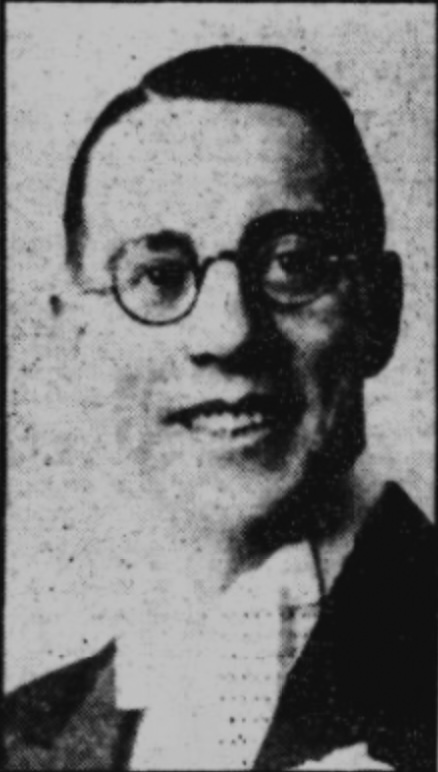
Syd Revill


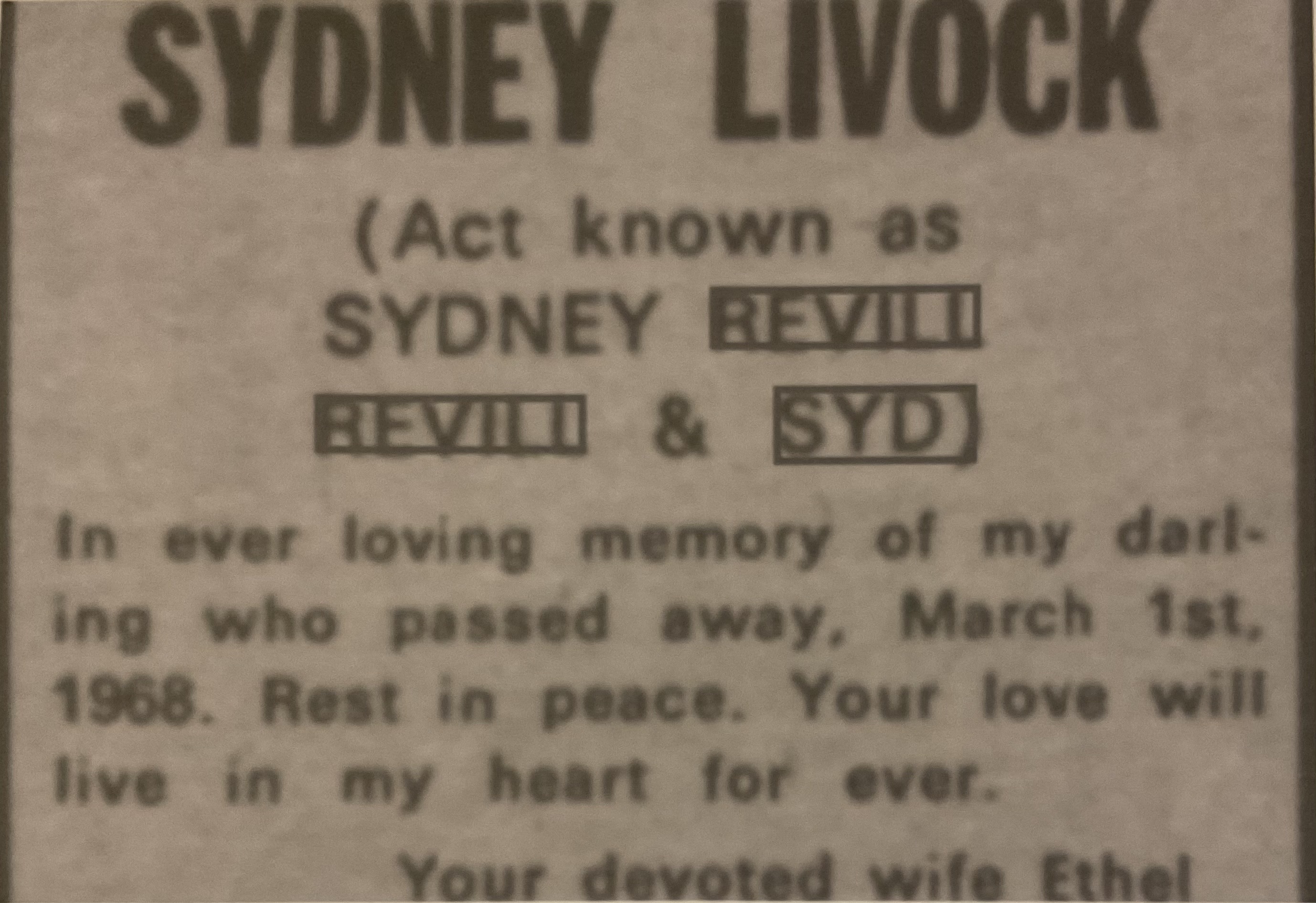
In 1969 his wife, Ethel, placed a notice in the trade paper, The Stage, in his memory. Syd and Ethel left a trace of their lives in the letters, scribbled scripts and contracts which I was lucky enough to find. Syd featured strongly in these but Ethel kept them safe. I wish I knew more about her.

Thanks to the British Newspaper Archive and the Monomania collection.

Not her brother, but her husband.

In a previous blog I mentioned Annie Casey, a performer I knew little about, but my interest was sparked by a postcard. The information I found was brief and sometimes conflicting, leaving me a little confused. This all changed recently when Annie’s grandson, Mike Casey, contacted me and was kind enough to share information about Annie and her husband Will. I had previously thought Will was her brother from a newspaper report of the time. I am so pleased and grateful to Mike and hope this blog puts the previous one to rights and does justice to a hardworking and interesting performer.

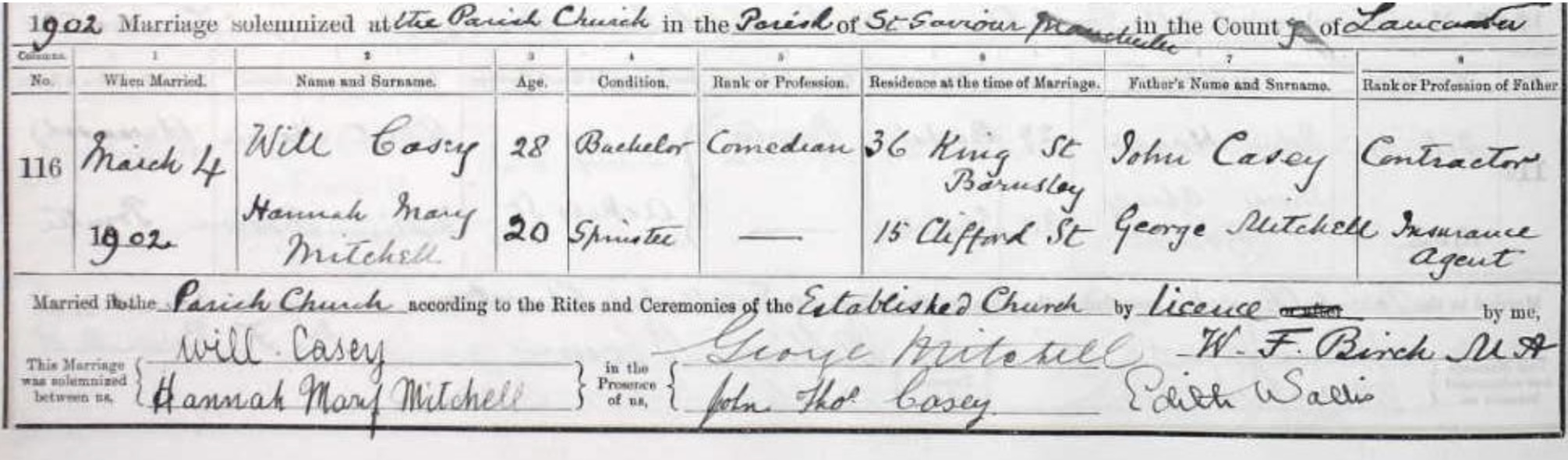
Annie Casey was born Hannah Mitchell in Wynyard Station, County Durham, and was the second of seven children born to George Mitchell and Emily Ann Gofton. She married Will Casey on March 4th 1902 at Chorlton upon Medlock, Manchester. The marriage certificate tells us that Will was a comedian but nothing is listed under rank or profession for Hannah. It was after her marriage that she began to perform on stage as Annie Mitchell, sometimes using the names Mrs Will Casey or Annie Casey.


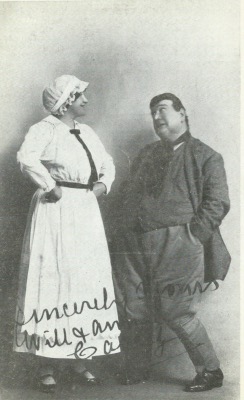
Annie and Will toured together as a double act and Will wrote and appeared in short plays. Annie joined him in many plays including Her Sailor Lover, The Lover’s Lament and A Wife’s Devotion, the latter being described as brimful of excruciatingly funny comedy.Their signature tune was a typically jolly Come Lasses and Lads which had originally been sung around the maypole.

On March 3rd 1927 Annie and Will put a notice in the trade paper, The Stage, celebrating their silver wedding saying the marriage had been 25 years of the best. May it long continue. Their address is given as 197 Sheffield Road, Barnsley. Will died the same year and Annie moved to Blackpool where she died in 1940.

In 1960 a letter was published in the Daily Mirror referring to a mention of Will Casey. Mrs N Greatorex de Vere wrote of having toured with Annie and Will, describing him as a comedian and Annie as a soubrette, and finding them a lovable couple. She goes on to say they travelled with a specially reinforced bed as landladies complained their beds could not support the combined weight of the Caseys. Will was 36 stone and Annie around 28 stone.


Thanks to Mike Casey, British Newspaper Archive, Monomania collection.


A Charming Presence

Lil Hawthorne was an American singer and comedienne, born in 1877. After various childhood acting roles she headed for the variety stage, aged fourteen, as one of the Three Sisters Hawthorne. There was a fashion for ‘sister’ acts at the time but, unlike many, the Hawthornes were three real sisters. They came to London from New York and in June 1898 the Music Hall and Theatre Review enthusiatically proclaimed they achieved ‘an instantaneous success’. One of their successes was in an operetta The Willow Pattern Plate performed at the Oxford, the Tivoli and the Pavilion – all London halls.

Despite their popularity, two of the sisters returned to America while Lil tried her luck as a solo performer. In 1900 she was starring on the Moss and Thornton circuit travelling to South Shields, Hull, Liverpool, Manchester, Bradford, Glasgow and Edinburgh. The Edinburgh Evening Dispatch described her as ‘the original warbler of several world-known medleys’ adding that she had a sweet voice with due regard for modulation. Sweet Rosie O’ Grady was her most popular song with another favourite being I’ll be your Sweetheart, a song my grandmother sang after a glass or two of Guinness. Reviews suggested she marked a step forward in the entertainment of the music hall, being both charming and refined. The owners of the halls were struggling to cast off their less than savoury image and Lil appealed to their vision of the future. She was also a popular principal boy in pantomime for some years.

Belle Elmore

In 1899 Lil married John Nash who became her manager and they later became involved in the case of Dr Crippen and Belle Elmore, an aspiring music hall performer but with little talent. Lil Hawthorne and Belle Elmore were both members of the Music Hall Ladies’ Guild where Belle was treasurer. They became friends and the two couples would visit one another and dine together. The Nashes were visiting America when Crippen’s secretary, Ethel Le Neve, visited Melinda May, secretary of the Ladies Guild and gave her a letter. The letter was written by Dr Crippen saying that Belle had gone to America owing to the illness of some relatives and that a new treasurer should be elected for a few months. Nothing was received from Belle herself.

On their return Lil Hawthorne and her husband were told the story of Belle’s illness and death in America. They were worried by the turn of events and John Nash tried, unsuccessfully, to find out where Belle had died and where she was cremated. By this time Ethel Le Neve had moved into the Crippen’s house and was wearing some of Belle’s jewellery. Others in the music hall world were worried and Vulcana, the strongwoman, had approached the police with her fears. John Nash talked to Crippen and was so disturbed he took a taxi straight to Scotland Yard.

Dr Crippen and Ethel Le Neve were arrested en route to Canada on an ocean liner with Ethel Le Neve dressed as a boy. They were posing as father and son but aroused suspicion and the newly invented telegraph was used to relay the information to Scotland Yard. Human remains were found buried in the basement of 39 Hilldrop Crescent, the Crippen’s home. Crippen was found guilty and given the death sentence while Ethel Le Neve was exonerated. Lil Hawthorne and John Nash gave evidence at the trial in 1910 and in 1911 the Treasury authorised payment to them of £100 to cover expenses incurred and loss of earnings. A few years later they moved to America where Lil Hawthorne died of heart problems in 1926, aged forty-nine.


Thanks to the British Newspaper Archive and the Monomania collection.

The Latest Scourge

The latest scourge – a term used to describe the flu pandemic of 1918/19 when the country was already reeling from the devastating effects of the First World War. Theatres and music halls were a welcome escape for many of the population and the authorities saw them as a morale booster in difficult times. There was much debate as to whether music halls should remain open and which, if any, preventative measures should be taken. Local authorities took their own decisions. By October 1918 no regulations had been issued in Oxford as to the closing of places of amusement, even though influenza was rife. Audiences declined considerably and the military authorities placed music halls out of bounds for infantry cadets, although Royal Air Force cadets could still attend. In contrast, at the beginning of November 1918 the licensing committee in Birkenhead issued regulations covering the opening of music halls. The first performance was to take place between 6.30 and 8pm with the premises thoroughly ventilated until 8.45pm when the second performance began. Children under fourteen were not to be admitted under any circumstances and overcrowding should be avoided. Scrupulous cleanliness was expected.

In many areas the military of all ranks were forbidden to attend the halls which had a severe effect on their takings and led to calls for restrictions to be eased. Various medical experts shared their opinion that it was useless to close places of amusement while allowing travel on omnibuses and trains. Oswald Stoll, music hall manager, declared that the epidemic was much more likely the result of a diet lacking in fats and sugar than visits to the music hall. The London Palladium installed an ozone ventilating system and sprayed a strong germ killer all over the theatre between each performance. The Illustrated London News suggested there was no better preventative than a good sneezing fit once or twice a day and various manufacturers talked up the efficacy of their products.


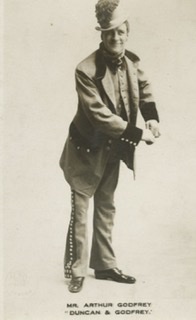
Despite some measures to combat the virus it dealt a blow to performers as well as audiences with popular artists unable to perform. The trade papers sought to play down the seriousness of the outbreak but were reporting many stand-ins for advertised artists. Daisy Jerome, irreverent mimic and singer, cancelled her appearance at the Palladium after succumbing to influenza while coster act, Duncan and Godfrey, appeared at the Holborn Empire still suffering from the after effects of the illness. Anthony Burgess, the writer, tells us of his mother’s death from influenza in 1918 when he was two years old. He talks about her life in music halls and her marriage to his father, a pianist in the pit orchestra. I can find no other evidence of Elizabeth Burgess/Wilson appearing on the halls and would be grateful for any information.

Elizabeth Burgess Wilson

Music halls were perhaps more fortunate here than in the States, Canada and Australia where the halls closed for weeks at a time inflicting severe hardship on performers and venues. In her autobiography, Take it for a Fact, Ada Reeve talks of being hospitalised with flu in South Africa with theatres closed and the public warned not to go to places of amusement. All in all, many parallels with the current pandemic and then, as now the fervent wish was to get back to normal.

Ada Reeve


Thanks to British Newspaper Archive, thestage.co.uk, Take it for a Fact – Ada Reeve
Photograph of Elizabeth Burgess/Wilson reproduced with kind permission of the International Anthony Burgess Foundation


I’m an old hand at love

0FD29E9F-BBD6-42EC-A545-1BD413C1468AMinnie Cunningham was a music hall singer and dancer, best remembered for featuring in a painting by Walter Sickert. She was born in Birmingham in 1870, the daughter of music hall comic singer Ned Cunningham. He was well-loved and successful, being described by the Birmingham Gazette as the ‘greatest comic singer in the world.’ His daughter started her music hall career after his death when she was ten years old. Minnie Cunningham tells us she began as a male impersonator and sang her father’s songs, although reviews of the time don’t mention male impersonation, only her singing and dancing. She moved from the provincial halls to London where she performed at the principal halls of the day.

It was during her London success that Minnie Cunningham was introduced to the 31A333B7-D7C4-4610-B0B0-EAC59D94897Epainter Walter Sickert by the poet and music hall critic Arthur Symons. Both men were smitten by the popular artiste and Sickert arranged to paint her portrait. The figure of Minnie Cunningham was painted from life in Sickert’s studio in Chelsea in 1892. For this painting she stood on a raised stand as if she were on stage but when asking her to pose for a later painting Sickert writes that he had built a proper stage  ‘six foot square, with steps up to it.’ The background is thought to be the Tivoli on the Strand in London where Sickert had seen her perform. The painting was originally entitled, Miss Minnie Cunningham ‘I’m an old hand at love, though I’m young in years.’ This was one of her popular songs at the time and while singing it she dressed as a young girl which made the performance more daring. The painting became known as Minnie Cunningham at the Old Bedford. It was exhibited for the first time at the New English Art Club in 1892 to a mixed reception, with a reviewer in the Pall Mall Gazette writing ‘The red dress of Minnie Cunningham glows with refined richness in its setting, but the proportions of the figure and the feet and hands seem altogether absurd.’ The subject and setting were just too shocking for many at the time and it was said by some to represent degradation and vulgarity.

Minnie Cunningham remained popular for some years, performing, writing songs for herself and others and appearing in pantomime. She maintained it was very difficult to gauge the public taste in choosing a song but her compositions ‘The hen that cackles the most’ and ‘Give us a wag of your tail, old dog’ seem to have hit the mark. Minnie spent time in Ireland, calling herself ‘the Little Irish Gem’ and a tale is told of male admirers turning up with glass bottles to throw at the performer who replaced her at the top of the bill, giving us an idea of her popularity.

While in Ireland she claimed £500 through a court case for alleged breach of 9D63B80C-0979-452C-A9E1-EBFD29E749B3contract in which she was engaged as principal girl in the Jack and Jill pantomime at £30 a week. She refused to wear the costume for her part saying it was too short and offended her standards of decency. Discussions with management were unsuccessful, often ending in tears. Eventually another performer, Edith Fink, was appointed to the role and had no complaints about the length of the costume. At one point in the court proceedings the two performers removed their hats and boots and stood back to back on a table to see who was the taller of the two. Minnie Cunningham was undoubtedly the taller and was asked to put on the costume for the jury’s eyes only. There were rumours that she was worried that Dorothy Ward playing the part of Jack, an extremely well-known and talented performer, would outshine her. The jury could not agree on a verdict and were discharged.
53156582-82D5-4CA2-AD2E-7C908FC11B21

Dorothy Ward

Minnie Cunningham lived with her mother in Southgate Road, Hackney. Her mother died in 1916 and Minnie seems to have retired shortly after this. She died in 1954 at the age of eighty-four and her later life is a mystery. She remained in Southgate Road, but her obituary tells us only of Minnie’s performing life taken from her own words.


Thanks to britishnewspaperarchive.co.uk
                   monomania postcards (@monomaniablogs)
                   Walter Richard Sickert & the Theatre 1880-1940. PhD thesis submitted    University of St Andrews by William Rough 2010


An update on the mysterious relative

I’m very pleased to have found out a little more about the life of Marie Levison/Kate Toole who featured in the previous post. Thanks to the help of @heathertweed my enthusiasm was renewed for more research. Marie/Kate was born in 1859 in Worcester and her original name was Catherine Lee. She was one of nine sisters which included my friend’s Great Grandmother, Jane Lee. It seems the family cast her adrift when she went on the stage. This story had come down through the family but was still not really talked about. According to her obituary, Catherine started her career under the stage name Marie Levison, singing and acting with various companies until she was engaged by the D’Oyley Carte company. It seems she spent some years there and then as Kate Toole took to the music halls and pantomime where, for a time, she enjoyed success. She was said to have an excellent stage presence and a rich sympathetic voice.

While my friend found out about Catherine’s beginnings I looked into her death and burial guided by @heathertweed. Kate Toole, as she was still known, died of alcohol poisoning and had been found in bed by her landlady. She was living in Bermondsey and was buried on March 5th 1903 in Nunhead Cemetery. She was 44 years old when she died. Kate was buried in consecrated ground but in a public or communal grave along with twenty-one other people. This usually happened when the deceased had no resources to pay for a private grave or no relatives prepared to pay the costs. As Catherine had changed her name twice it’s possible her family had lost track of her – a better thought than that they refused to help. The site of the grave is now a nature reserve.

The obituary states that, in her day, Kate Toole was a popular and much appreciated artiste but that in later years her name had entirely disappeared from the London programmes. We will probably never know if her star faded and she took to drink or if alcohol was the cause of her downfall, as it was with so many music hall performers. I’m glad we could give her some recognition and I feel moved by her story and grateful to have had the chance to get to know her in a small way.

Thanks to @heathertweed, British Newspaper Archive, Nunhead Cemetery


The Mysterious Relative

436C4841-8B4A-4425-BBF2-893287C07448

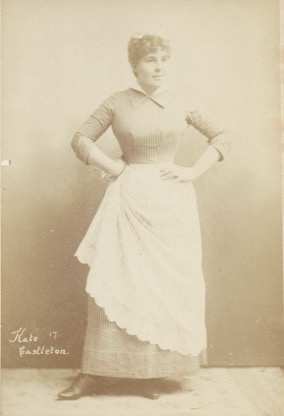
This photo is signed Marie Levison and is of the relative of a friend. Information is hard to come by and it seems Marie may have been the person in the family that no one talked about. Was she considered beyond the pale for embracing the theatrical life? We don’t know but would love to find out. The photo shows her as Dandini in the pantomime Cinderella at the Theatre Royal, Cardiff in January 1888. Marie Levison was not her real name, which could have been Kate Lee, and she changed her name again to Kate Toole in October 1888. It wasn’t unusual for performers to change their names if they took on a new act or hoped to leave an unsuccessful career behind, but why did she do it?

We know that Marie Levison had been with the D’Oyley Carte Company for some years and then switched to music hall. We don’t know why she did this. As Kate Toole she appeared on various bills and seems to have been well received although never appearing as the star turn. She was represented by Hugh J Didcott who was one of the leading agents of the time. Didcott had a dispute with the leading music halls which he lost and many of the music hall stars left his agency which meant he was left with the less popular artistes. When did he represent Kate? Did she stay with him? We don’t know the date of her birth but sadly we know how she died. The Brighton Gazette reported in March 1903 that Kate Toole was found dead in bed by her landlady. The cause of death was given as alcohol poisoning.

If anyone has any more information on Marie/Kate it would be wonderful if you could share it and I’ll pass it on to the friend with the mysterious relative.


Thanks to the British Newspaper Archive and the British Music Hall Society.

Roller-Skating: An Aid to Health

The general population in the early 1900s was as susceptible to fashion and new-fangled ideas as we are today. The craze for roller-skating came over from America and swept the country. As ever, the music hall reflected life in the outside world and took the opportunity to bring new delights to its audiences. Roller-skating acts were soon included in music hall programmes and managers were encouraged to update the halls with flooring to accommodate skaters, or rinkers as they were known. As seen below, the suggestion seems to be that rinkers could use the halls for skating between performances and managers could cash in at the same time.

A163F034-3EB2-4CED-B9A2-5EE41B5D298E

Specialist roller-skating rinks opened all over the country for the general public but were not universally popular among those already providing other forms of entertainment. In some areas publicans organised an anti-rinking campaign and billiard saloon owners met to discuss the way to combat the attraction of roller-skating. The trade paper, The Era, tells us that music halls seemed not to suffer a decline in trade and the manager of a large venue declared that skaters liked a quiet seat at an entertainment at least one evening a week. This may have been wishful thinking as Mr Alfred Graham, proprietor of the Hull Hippodrome and Middlesbrough’s Oxford Music Hall, was declared insolvent and blamed skating rinks for his troubles.

Health benefits were said to be gained from roller-skating with even the most BE3D3A36-13DE-4723-98BF-8BB09D9B57F6delicate people finding it beneficial. Headaches would become a thing of the past as the blood coursed more vigorously through the veins. Little is said about falls and broken limbs. Seeing the experts performing at rinks and music halls increased the popularity of the pastime with participants attempting dance steps and couple dancing, with mixed results.
326EEF08-1E76-4E68-9F79-BF0C1E4CB870Dolly Mitchell was a young Scottish roller-skater who teamed up with her American teacher, Harley Davidson, to give displays in rinks and music halls. Advertised as the greatest skaters in the world and giving a wonderful exhibition of trick, fancy, acrobatic, graceful and artistic skating. They displayed over £1,000 worth of gold and diamond medals won in competition. When appearing in Scarborough they cake-walked, two-stepped and waltzed on roller-skates before executing a perfect ballet dance. Harley Davidson described Dolly Mitchell as being sixteen years old, the daughter of a doctor in Aberdeen and the granddaughter of ‘old John Begg’ a whisky distiller. They visited London to have a portable maple floor made to fit any stage at a cost of £140 and Harley boasted they would be ‘the first roller-skating dancers and poseurs to travel with such a flooring’.

Rosey Anslow and Ella Grahame were working in Poland AB13BD1D-B9AD-4060-8092-EDBDB7E5C0E3and had this publicity photo taken by Léo Forbert’s studio in Warsaw. Ella writes on the back of the card ‘What price this for swank. Do you like me in pants? The people can’t get past the size of my bottom here’. Let’s hope the audience appreciated their skill as well.

Information worth sharing is that Mr H. W. Izod, manager of a roller-skating rink in Earls Court London had, on two occasions, entered a wild beasts’ cage in public. The first time he played a game of ping-pong in the presence of eleven lions and the second time he shaved another man with fifteen lions around him. He was said to be a sworn enemy of monotony.

The rinking craze was short-lived and by 1911 many rinks had closed with investors losing considerable sums of money. However the music hall soldiered on.