Category Archives: Music Hall singers

Bonny Kate Castleton

Kate Castleton

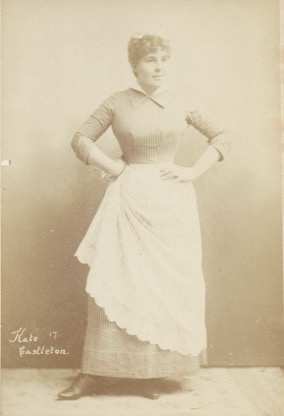
Kate Castleton was an early music hall performer and, as such, her formative years are difficult to trace. She was almost certainly born in 1856 in London and her last name was Freeman. There are varying accounts of her first name, the most common being Jennie, with Jane and May being other possibilities. Before she became a professional performer she said in a newspaper interview she worked in a factory making smoking-caps, was a member of a church choir and sang at temperance meetings. Information about this part of her life is hazy and the truth may have been given up for a story that would sit well with the public.
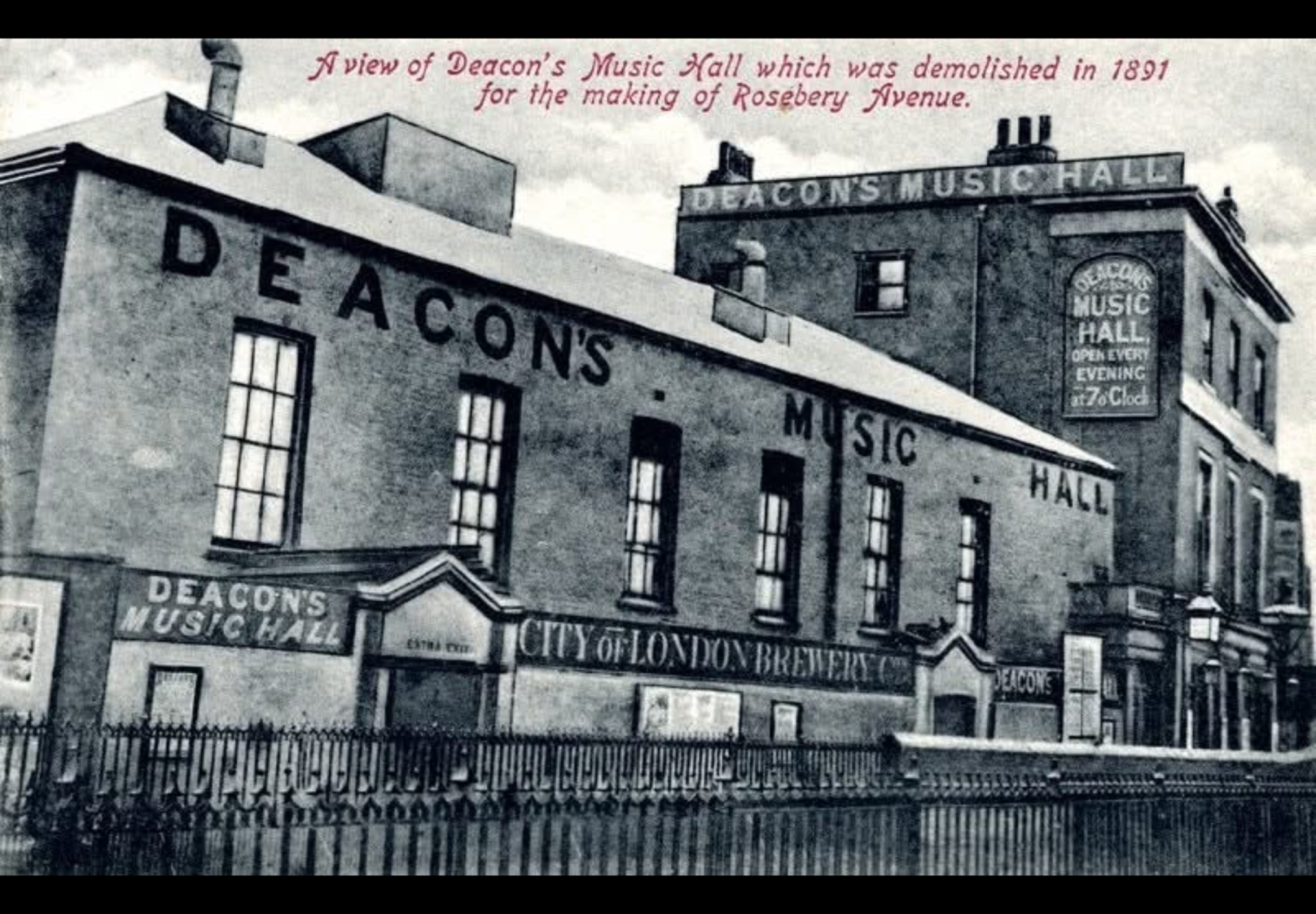


In 1875 there are accounts of her singing in the newly renovated Deacon’s Music Hall in Finsbury, London. She is described as a serio-comic with one rather patronising reviewer commenting, ‘in time, we should say that she will become popular.’ The trade paper, The Era, tells us Kate is nice-looking, wears good dresses and sings clearly and forcibly. She had been taken in hand by JW Cherry, a music teacher and composer of music hall songs. Mr Cherry was proud of his pupil and in 1876, during her Benefit at the London Alexandra Music Hall in the New Cut, he led her to the footlights where she was greeted with loud and protracted applause. The audience was known to be rowdy in that hall but her song Popsy-Wopsy found special favour and her dancing was said to be excellent. JW Cherry placed adverts in the trade papers offering tuition and boasted of Kate’s immense success everywhere.
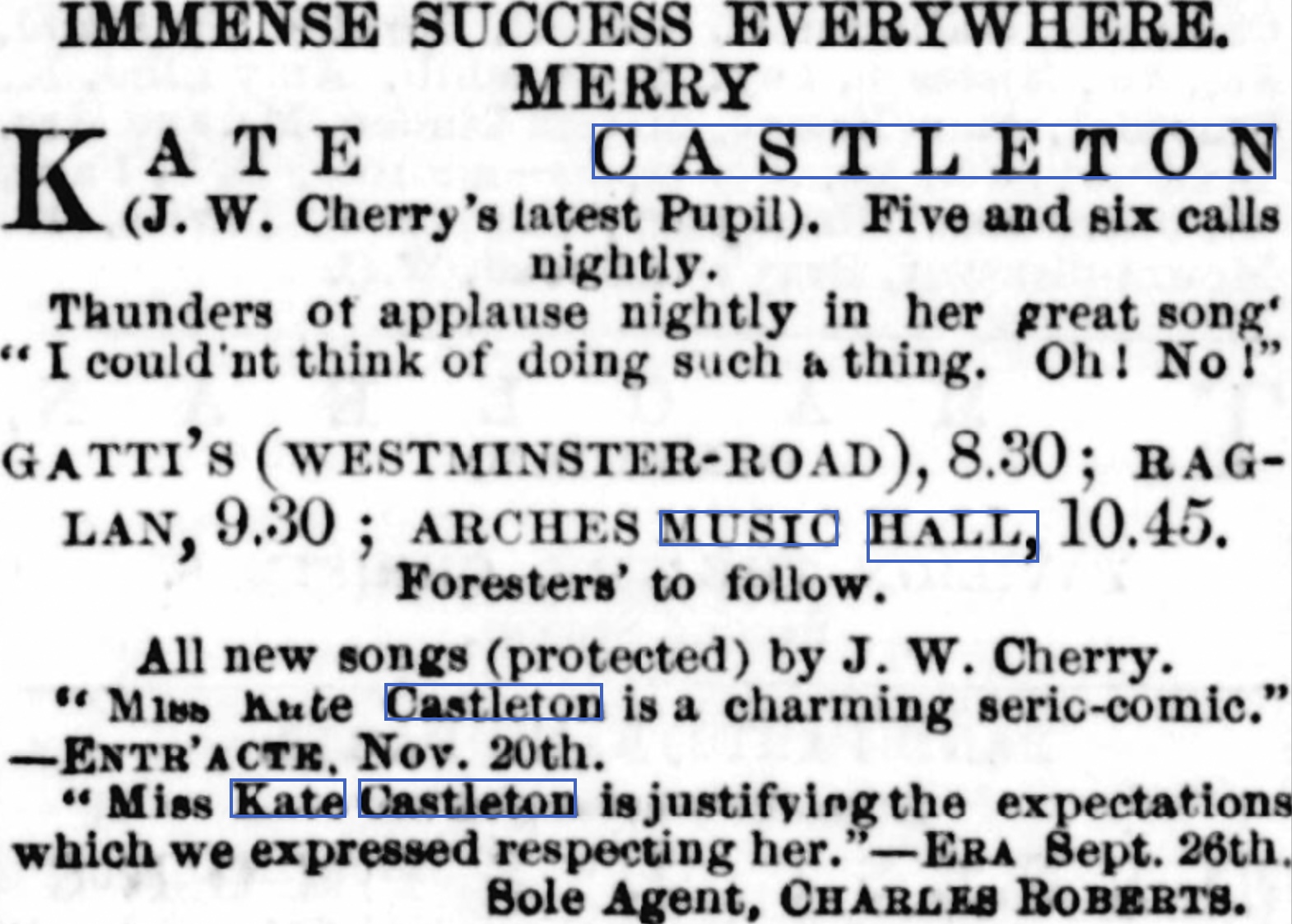
However, in 1876 Kate was offered work in the States by Josh Hart who ran the Eagle Theatre in New York. On September 2nd 1876 JW Cherry put an angry notice in the Enr’acte, a trade paper, ending all contracts with Kate Castleton and stating his intention to divide her songs among his other pupils, taking away her right to sing them. She had unfinished business with Cherry and had not re-signed her contract with him. She could no longer sing songs such as Come Along, h’Isabella containing the lyrics ‘Come along h’Isabella, H’under me h’umbrella.’
Screenshot


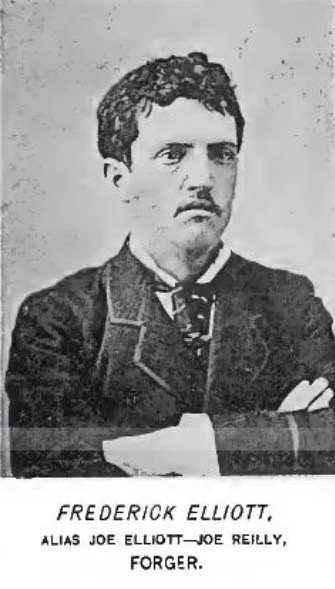
Kate started out at the Eagle Theatre and was a great success. One of her admirers was Joe Elliott, a forger, who had been in prison in more than one country and had a link with the murder of a fellow forger’s wife. She knew something of his criminal life but married him in the hope he would put it all behind him. The year after their marriage Elliott forged a draft for $64,000 on the New York Life Insurance Company. He was arrested but escaped and went to Boston where he stole $8,000 from a jeweller and was subsequently given a prison sentence of five years. Kate tried to secure his pardon but was unsuccessful. They lived together when Elliott came out of prison but soon divorced. They got back together and married again but in 1884 she was divorced again. Three days after getting this divorce she married Harry Phillips a theatrical manager. Phillips was her manager in the ‘musical plays’ she appeared in. In 1888 she was granted a divorce from Phillips on the grounds of his drunkenness and cruelty.

.
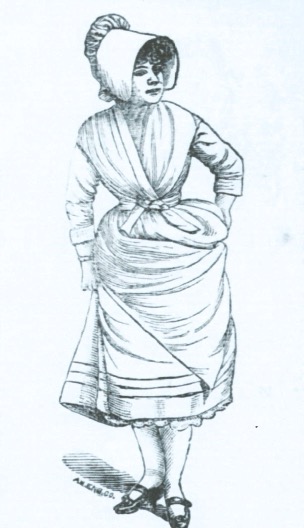
Kate had earned a good living in American theatre and bought two adjoining houses in Oakland, California in 1889. Her husband and some of his family lived in the larger house at the time of their divorce. They refused to leave and eventually Kate paid them to go – said to be $4,000. Kate’s family moved in, her sister occupying the smaller house, while Kate lived in a New York flat. In 1892 Kate died and various causes of death were given in newspaper obituaries. She was said to have died from a heart attack, peritonitis and death as the result of blood poisoning from a lotion used to treat sunburn. There is a strange addition to a report in an American newspaper reporting her death. It reads ‘Kate Castleton was never popular with professional people.’

Thanks to British Newspaper Archive, Ancestry, Monomania collection, Newspapers.com
From Theatre to Music Hall

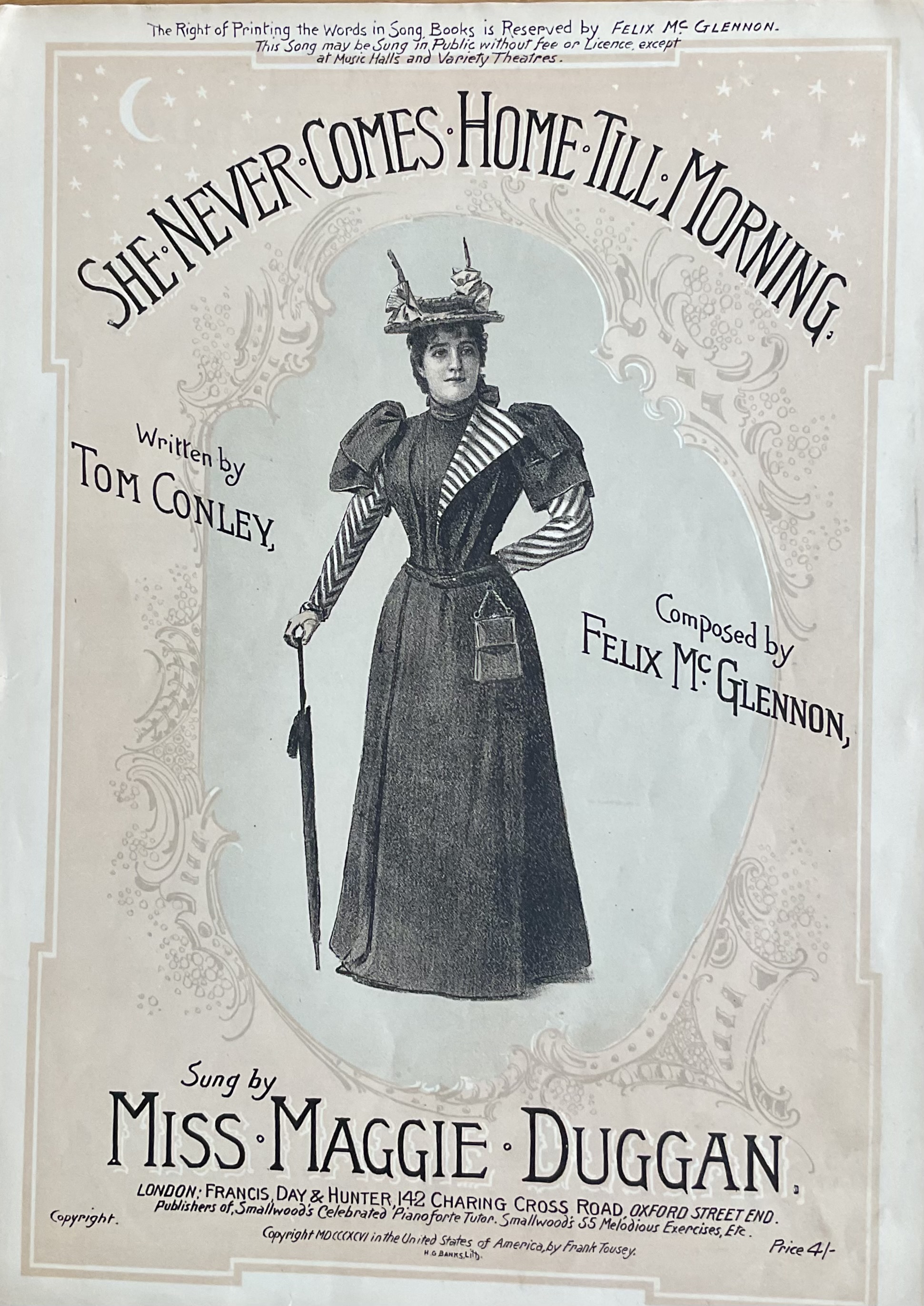
This is an amended version of my original post on Maggie Duggan as a reader has very kindly given me the correct information about her birth. She doesn’t have a birth record at the General Register Office in London, which was common amongst poorer families. She was born in Liverpool in 1857 and not 1860 as I had thought. The 1861 census shows her family living at 47 Blenheim Street in Liverpool. Her mother, Mary, is listed as the head of the household and as a sailor’s wife. Maggie was six months old and her sister, Sarah, was nine. Both Mary and Sarah have their place of birth listed as Ireland which could explain the later confusion over Maggie’s birthplace and accent when she was on the stage.

In an interview in the trade magazine, The Era, Maggie revealed she made her first appearance in a pantomime in her early childhood at the Adelphi Theatre, Liverpool. Her salary was three shillings a week and she was expected to provide her own boots. She disagreed with people who thought it wrong that children should act in pantomime saying ‘Tis very often delightful to the youngsters – – pantomime children are very often taken from poverty-stricken surroundings and taught the rudiments of an art that may bring them fame and fortune.’ The interviewer saw this as her opinion but it could have been her own experience.

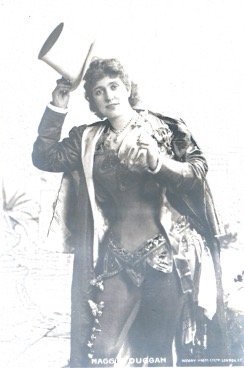
Maggie Duggan travelled as a member of a ballet troupe and then took the giant step of moving to the Cape as part of a theatre group. On arrival, she had trouble learning her lines and was so bad the manager declared he would send her home by the same boat that had brought her out. She persevered and added a hornpipe to her role which was so well received she stayed on and was at the Cape for two years. On her return to England she worked with burlesque and comic opera companies where she performed ‘breeches parts’ saying that she would feel dreadfully ill at ease in petticoats. The newspaper article is careful to add ‘that is, of course, on the stage.’ She thought a woman of her size looked ungainly in skirts on the stage.

There is a confusing remark from Maggie Duggan that the heroes of musical comedy were all played by men and, although she loved that kind of entertainment, she was looking for something different. Does this make sense after the breeches roles? Perhaps they were all burlesque. Maggie made a big splash with the Gaiety company in the second outing of the burlesque, Cinder-Ellen Up Too Late, taking the part of the Prince of Belgravia previously played by a man. During the performance she sang two music hall songs – The Man who Broke the Bank at Monte Carlo and The Rowdy-Dowdy Boys.The first of these had been plugged by Charles Coburn at The Oxford but when Maggie Duggan sang it Charles Coburn’s share of the royalties rose to £600. The other song was a music hall hit for Millie Hylton.

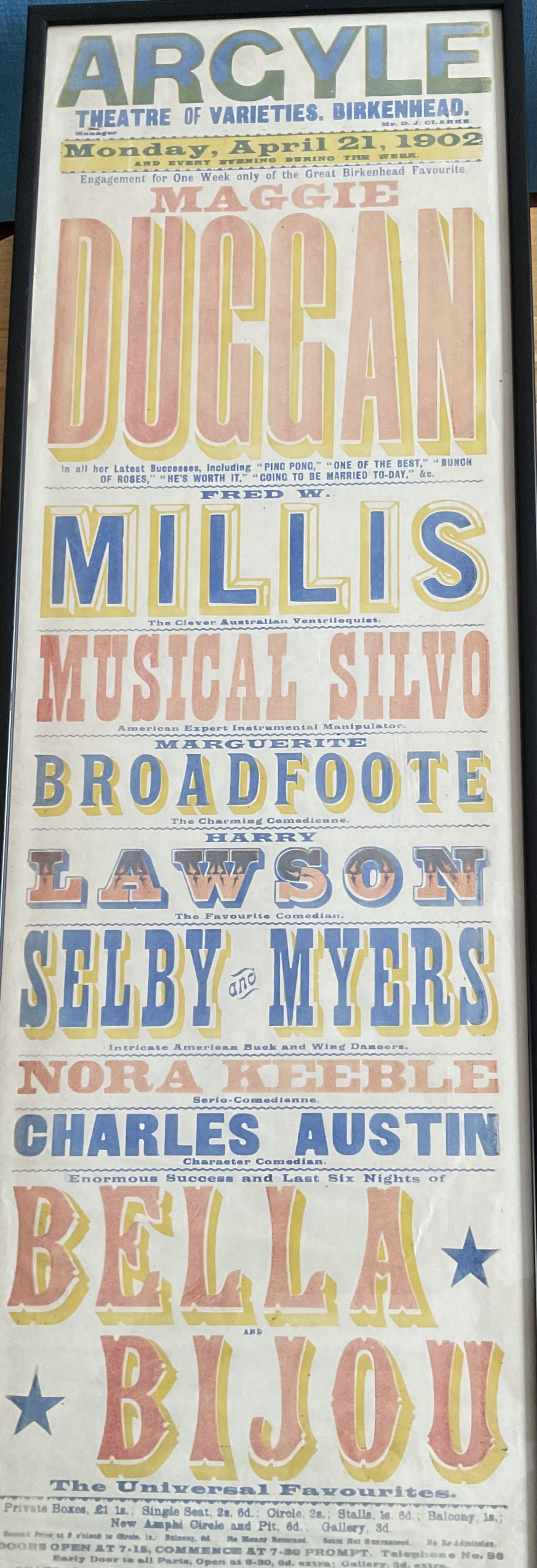
The popularity of these songs may have finally decided Maggie Duggan to switch to music hall, although it wasn’t always easy. She lamented the lack of good songs saying she could buy a hundred and just find one worth singing. In 1900 there is an advert in the Music Hall and Theatre Review placed by Maggie Duggan requesting good low comedy and character songs. She found the lack of rehearsal in music halls equally hard as the band could often be at cross purposes with the singer during a performance. Also, in her previous career she was better known on the provincial stage and worried it would be hard to get work in London halls.
This may have been unfounded as in 1894 we find in The Era that she moved from Birmingham to the London Alhambra and ‘other west end halls.’

Maggie Duggan excelled in pantomime with her height and build making for an excellent principal boy. She was in demand in Leeds, Manchester, Liverpool and, perhaps best for her career, Drury Lane. Ada Reeve in her autobiography, Take it For a Fact, talks about working with her in Little Boy Blue in 1893. Maggie Duggan played her role as principal boy ‘in the dashing, strutting manner peculiar to those days. Her trademark was a diamond butterfly which she wore pinned to her tights on her thigh.’

In June 1905 a headline in the London Morning Leader proclaimed in heavy type, Bigamy with Maggie Duggan. The court case was brought by Mrs Amy Ward against her husband, Thomas William Ward, and she asked for the dissolution of her marriage which had taken place in 1892. The couple separated in 1895 and Amy Ward alleged her husband was guilty of desertion, bigamy and misconduct. She had recently discovered her husband had entered into a bigamous marriage with Maggie Duggan. The petitioner had her watched when she was appearing at the Tivoli Music Hall, Manchester, and discovered that she and the respondent were living as man and wife. Mr Ward admitted the bigamous marriage but had been under the impression his wife was dead. Maggie Duggan was a widow when she married Mr Ward who had shown her a newspaper advertisement which she believed to be a notice of the death of his former wife. Mrs Ward obtained a degree nisi with costs.

Maggie Duggan died in 1919 in the Liverpool workhouse infirmary from bronchial pneumonia accelerated by alcohol. She was sixty years old and had retired from the stage some fifteen years earlier.

Thanks to The British Newspaper Archive, Monomania archive, Winkles and Champagne -Wilson Disher, Take it for a Fact -Ada Reeve

Many thanks to Raymond Crawford who took the trouble to read the post and contact me with the correct information.


.