
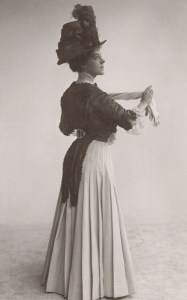
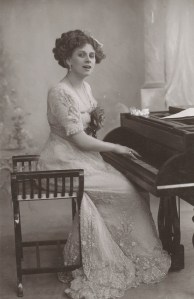
 Ada Reeve was born in London in 1874 into a theatrical family and she made her debut at the age of four in the pantomime Little Red Riding Hood at the Pavilion Theatre, Whitechapel. Using the name Little Ada Reeve she continued to appear in plays and pantomime to great acclaim. Her elocution was said to be ‘peculiarly free from Cockney taint.’ In an advertisement in the trade paper, the Era, in May 1884 Little Ada Reeve announced she was at liberty for speciality and Christmas for the principal child’s part and was said at ten years of age to be a singer, actress, dancer, reciter and drum soloist.
Ada turned to the music hall when her father became ill as a way of earning more money to support her large family. Her first appearance at the age of fourteen was at the Hungerford Music Hall, better known then as Gatti’s-under-the-Arches in Charing Cross. She delivered comic songs, the words of which she is reported to have spoken with a little singing at the end of each line. She was a dainty dancer and not averse to finishing her act with a cartwheel across the stage encouraged by the audience shouting, ‘Over, Ada’. Eventually she gave up on this, telling them, ‘I’m grown-up now!’ Her popularity was such that when she appeared at the Hippodrome Portsmouth in November 1907 her name featured seven times in the advertising material with theatre patrons urged to buy tickets at once owing to the great demand for seats. We are told it was a special engagement at a millionaire salary. The rest of ‘the wonderful star company’ is squeezed in at the bottom of the advert.
 Ada also made a name for herself as an actress and performed in musical comedy travelling to the States, South Africa and Australia appearing in theatres and music halls and winning admirers wherever she went. In interviews she was quick to dispel the myth of drinking champagne out of slippers and insisted it was all very proper with the evening ending with a thank you and goodnight on the doorstep. She received many letters from stage door johnnies and in a production where she played the part of an actress she would sometimes amuse herself by reading out these real billets-doux instead of sticking to the script.
In 1905 Ada sued the Weekly Dispatch for misrepresenting her in a published interview. She was read the article before publication and objected to certain content but it was published anyway with her signature as if she had written it. The article stated in a headline that Ada Reeve earned £250 a week and she denied having said this as it was untrue and would make her look foolish and boastful to say so. Other performers had mentioned it to her and it was thought to be in bad taste. She also denied signing the article. The defendants claimed she had not quite understood their intentions but agreed to pay her costs and the action was terminated.

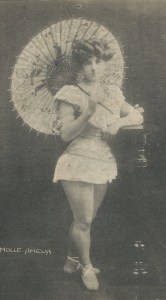
Ada was herself taken to court by Millie Hylton, ‘her stage rival’, whose counsel asked for Ada to be committed to prison. She had breached an undertaking not to sing Miss Hylton’s song I couldn’t help being a lady. Miss Reeve said she only sang the song once, as an encore, ‘because she had received so many encores that she did not know quite what to give.’ The judge said that Ada could have forgotten the undertaking in the excitement of the encores. He accepted her apology but she would have to pay the costs of the case.
 Ada Reeve continued to work as an actress on stage and in film. Her last stage role was at the age of eighty and she appeared in her last film at the age of eighty-three. She died in 1966 at the age of ninety-two. She had that special something which audiences responded to and in this clip we can see that charm and hear that voice, still clear in her eighties. She is talking to Eamonn Andrews after an appearance on the television show This is your life.
Thanks to the British Newspaper Archive, Fifty years of Vaudeville-Ernest Short, The Northern Music Hall -G. J. Mellor, The Big Red Book
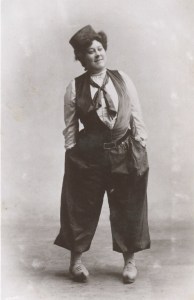
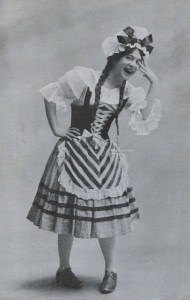


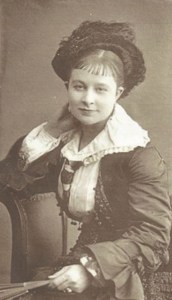


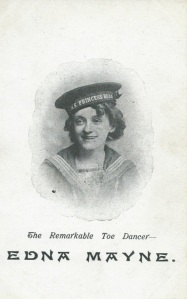 Edna Mayne is described as the Rembarkable Toe Dancer and in January 1911 we find her at the Palace Theatre, Gloucester, in Puss in Boots. She is described as an exceedingly clever sand dancer while her work on her toes was said to be very smart. A sand dance has been described as an eccentric dance with exaggerated movements while dressed in an approximation of Egyptian style.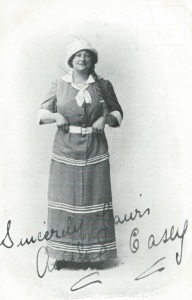
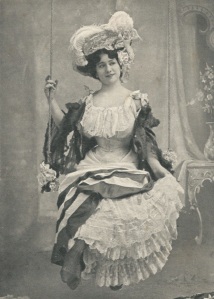
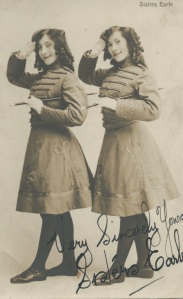
 Daisy Jerome was born in the States in 1888 but moved to England as a child when her father suffered a financial crisis. Money was needed and she followed her sister on to the stage. She was a small, dainty figure with bright red hair, compelling eyes and an expressive face. Her appearance belied her risqué performances and her hoarse, sensual voice. She was a toe-dancer and a wooden shoe dancer, but best known as a mimic and comic singer. Daisy married Frederick Fowler in 1906 but they lived together for less than a year with Fowler blaming the marriage breakdown on the constant presence of his mother-in-law. He filed for divorce on the grounds of Daisy’s misconduct. She was living with Mr Cecil Allen in Battersea by this time and claimed Allen would marry her if she was divorced. The decree nisi was granted with Fowler saying he would shoot Allen if he didn’t marry Daisy. She left for a three year tour of Australia shortly after accompanied only by her mother. She adopted the name ‘the electric spark‘ and seems to have lived up to this in her public and private life.


 Adelaide Gray came to this country from Australia with her son, Oswald, after the death of her husband. She married John Stoll who was the owner of the Parthenon Rooms in Liverpool and took over the venue shortly after John’s death in 1880. The Parthenon Music Hall was born. Adelaide was helped by fourteen year old Oswald who looked after the artistes backstage, eventually putting together the programme and booking the acts.
 The contract I have is for two artistes and the weekly salary is four pounds ten shillings between them so any fine would severely damage them financially. The contract is signed by Adelaide and Oswald Stoll.



 Into the Limelight