Category Archives: Music hall artistes

From Theatre to Music Hall
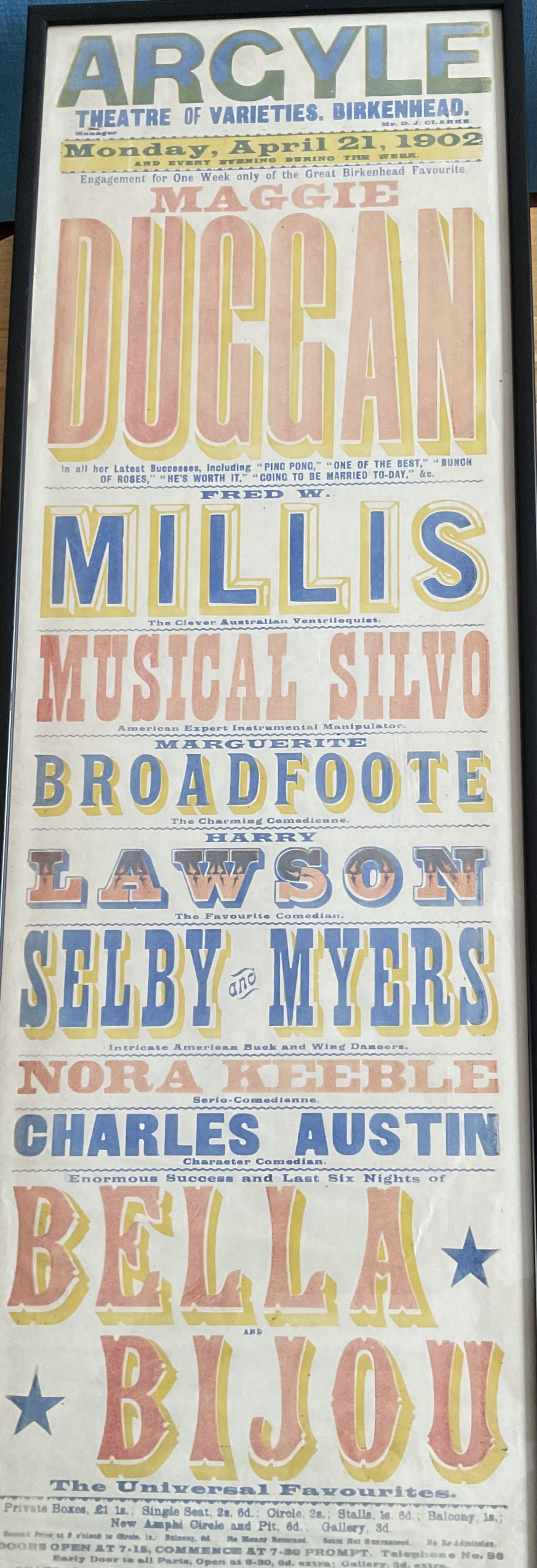
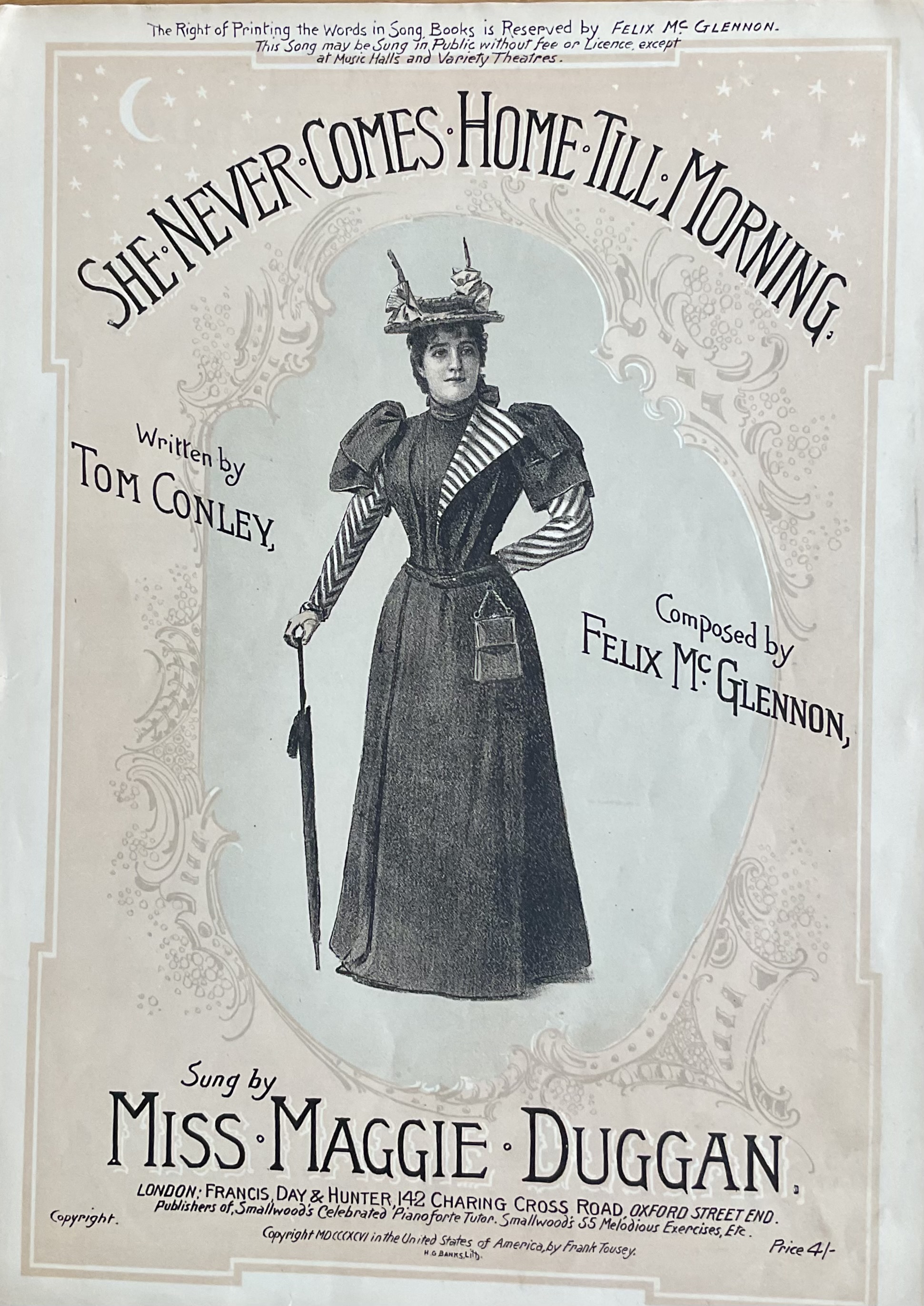
This is an amended version of my original post on Maggie Duggan as a reader has very kindly given me the correct information about her birth. She doesn’t have a birth record at the General Register Office in London, which was common amongst poorer families. She was born in Liverpool in 1857 and not 1860 as I had thought. The 1861 census shows her family living at 47 Blenheim Street in Liverpool. Her mother, Mary, is listed as the head of the household and as a sailor’s wife. Maggie was six months old and her sister, Sarah, was nine. Both Mary and Sarah have their place of birth listed as Ireland which could explain the later confusion over Maggie’s birthplace and accent when she was on the stage.
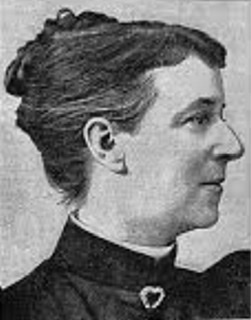
In an interview in the trade magazine, The Era, Maggie revealed she made her first appearance in a pantomime in her early childhood at the Adelphi Theatre, Liverpool. Her salary was three shillings a week and she was expected to provide her own boots. She disagreed with people who thought it wrong that children should act in pantomime saying ‘Tis very often delightful to the youngsters – – pantomime children are very often taken from poverty-stricken surroundings and taught the rudiments of an art that may bring them fame and fortune.’ The interviewer saw this as her opinion but it could have been her own experience.

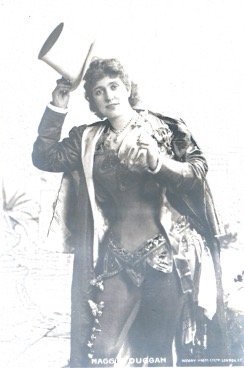
Maggie Duggan travelled as a member of a ballet troupe and then took the giant step of moving to the Cape as part of a theatre group. On arrival, she had trouble learning her lines and was so bad the manager declared he would send her home by the same boat that had brought her out. She persevered and added a hornpipe to her role which was so well received she stayed on and was at the Cape for two years. On her return to England she worked with burlesque and comic opera companies where she performed ‘breeches parts’ saying that she would feel dreadfully ill at ease in petticoats. The newspaper article is careful to add ‘that is, of course, on the stage.’ She thought a woman of her size looked ungainly in skirts on the stage.

There is a confusing remark from Maggie Duggan that the heroes of musical comedy were all played by men and, although she loved that kind of entertainment, she was looking for something different. Does this make sense after the breeches roles? Perhaps they were all burlesque. Maggie made a big splash with the Gaiety company in the second outing of the burlesque, Cinder-Ellen Up Too Late, taking the part of the Prince of Belgravia previously played by a man. During the performance she sang two music hall songs – The Man who Broke the Bank at Monte Carlo and The Rowdy-Dowdy Boys.The first of these had been plugged by Charles Coburn at The Oxford but when Maggie Duggan sang it Charles Coburn’s share of the royalties rose to £600. The other song was a music hall hit for Millie Hylton.

The popularity of these songs may have finally decided Maggie Duggan to switch to music hall, although it wasn’t always easy. She lamented the lack of good songs saying she could buy a hundred and just find one worth singing. In 1900 there is an advert in the Music Hall and Theatre Review placed by Maggie Duggan requesting good low comedy and character songs. She found the lack of rehearsal in music halls equally hard as the band could often be at cross purposes with the singer during a performance. Also, in her previous career she was better known on the provincial stage and worried it would be hard to get work in London halls.
This may have been unfounded as in 1894 we find in The Era that she moved from Birmingham to the London Alhambra and ‘other west end halls.’

Maggie Duggan excelled in pantomime with her height and build making for an excellent principal boy. She was in demand in Leeds, Manchester, Liverpool and, perhaps best for her career, Drury Lane. Ada Reeve in her autobiography, Take it For a Fact, talks about working with her in Little Boy Blue in 1893. Maggie Duggan played her role as principal boy ‘in the dashing, strutting manner peculiar to those days. Her trademark was a diamond butterfly which she wore pinned to her tights on her thigh.’

In June 1905 a headline in the London Morning Leader proclaimed in heavy type, Bigamy with Maggie Duggan. The court case was brought by Mrs Amy Ward against her husband, Thomas William Ward, and she asked for the dissolution of her marriage which had taken place in 1892. The couple separated in 1895 and Amy Ward alleged her husband was guilty of desertion, bigamy and misconduct. She had recently discovered her husband had entered into a bigamous marriage with Maggie Duggan. The petitioner had her watched when she was appearing at the Tivoli Music Hall, Manchester, and discovered that she and the respondent were living as man and wife. Mr Ward admitted the bigamous marriage but had been under the impression his wife was dead. Maggie Duggan was a widow when she married Mr Ward who had shown her a newspaper advertisement which she believed to be a notice of the death of his former wife. Mrs Ward obtained a degree nisi with costs.

Maggie Duggan died in 1919 in the Liverpool workhouse infirmary from bronchial pneumonia accelerated by alcohol. She was sixty years old and had retired from the stage some fifteen years earlier.

Thanks to The British Newspaper Archive, Monomania archive, Winkles and Champagne -Wilson Disher, Take it for a Fact -Ada Reeve

Many thanks to Raymond Crawford who took the trouble to read the post and contact me with the correct information.


.

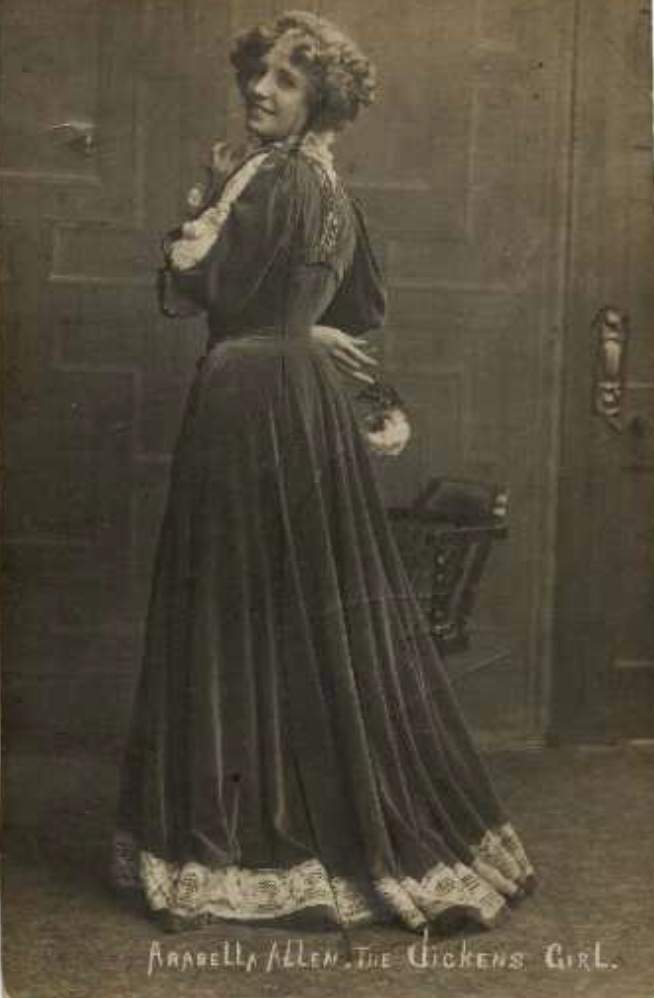
Arabella Allen – The Dickens Girl

During a visit to the Britannia Panopticon in Glasgow, the oldest music hall in the world, I was introduced to someone from the hall who very kindly shared the story of a member of her family who had been a music hall performer. Later she sent me pictures of the artiste in costume and these had such personality and presence that I was intrigued and wanted to write a blog about her.

Margaret Esther Clarkson was born in Liverpool in 1883. There are two dates given for her birth, 20th January and 22nd April. The earlier date is probably accurate as she was baptised on 18th February 1883 at St Thomas, Liverpool. By her own account she was an avid reader and re-reader of the works of Charles Dickens while growing up. He was so famous he would still have been in the minds of the public although he died in 1870. Margaret enjoyed mimicry and impersonation, moving from amusing her brothers and sisters to entertaining at amateur concerts. She gave impersonations of Shakespearean characters, recited monologues and played the violin. According to an interview in Cassells Magazine from July 1906 Margaret’s friends ‘were continually advising my parents to place me on the music-hall stage.’ She went on to say her parents were prejudiced against music halls and hesitated to encourage their daughter to become a professional performer on the halls. They did not want her to endure the precarious life of thousands of music hall artistes and ‘practically stipulated’ she should be a success from the start. Luckily, it seems she was.

Arabella Allen

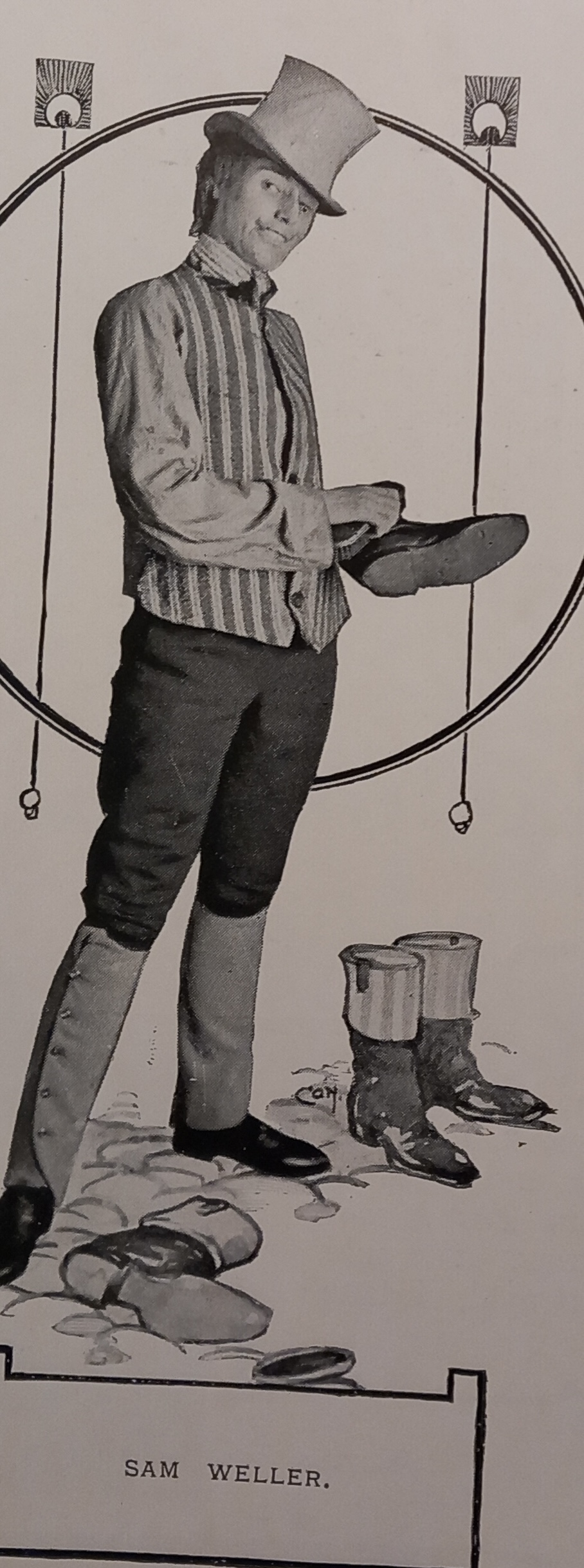
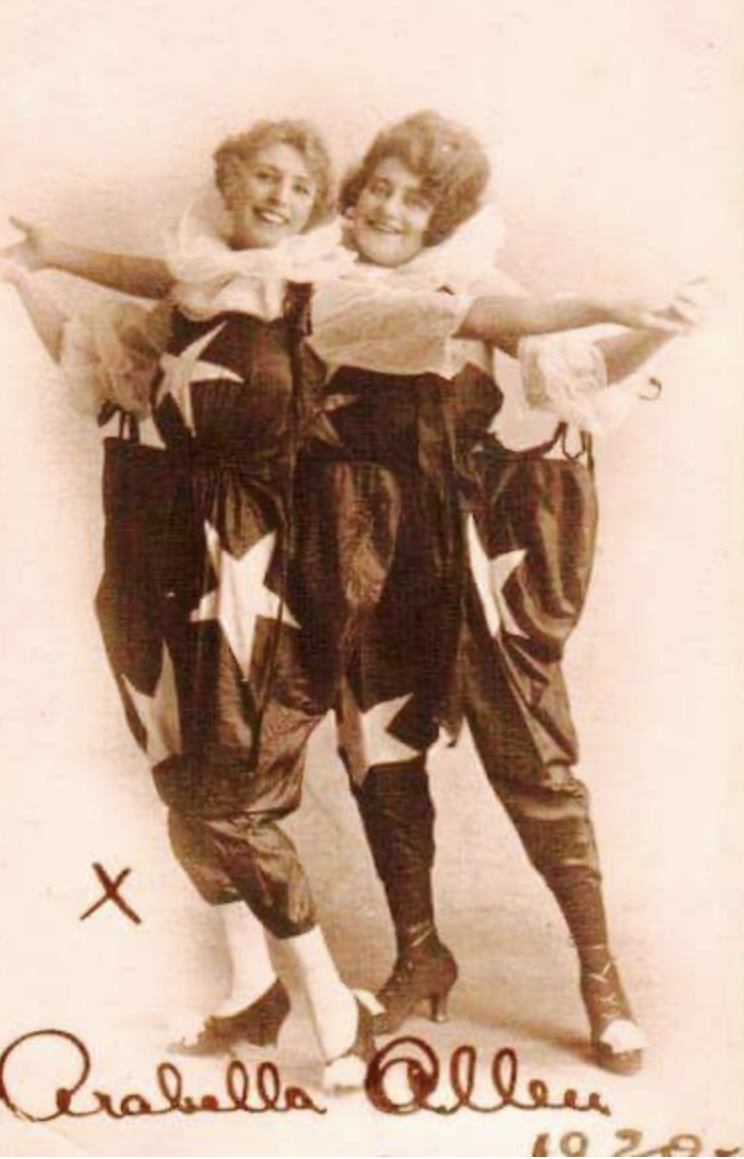
Margaret’s fondness for Dickens was put to good use as it was decided she should try some of Dickens’s male characters who would be reasonably well known. It also meant she wouldn’t be seen as a low entertainer, but rather a refined one. She used the stage name Arabella Allen, who was a character from The Pickwick Papers, and called herself ‘The Dickens Girl.’ Bransby Williams, a popular stage performer, had made a name for himself in the halls depicting characters from Dickens and Shakespeare before Arabella Allen appeared on the scene. I’ve been unable to find any reference to his opinion of this young rival. She received glowing reviews which mention her intelligence and engaging personality.

The Sketch


Arabella Allen started to be mentioned in the trade papers in 1904 with The Sketch featuring a page of photos from her act at the London Pavilion. She seems to have caught the eye of magazine editors and in July 1906 Cassells magazine included a long interview with Arabella entitled Marvels in Make-up. The magazine’s editor called it a very curious and remarkable article. He pointed out that ‘several other stories and articles will be found in our issue, but I have ventured to select a few outstanding features so that our readers may realise, that every month we are making special efforts to maintain the reputation of Cassells Magazine for lively, interesting and entertaining matter.’ The magazine had articles, short stories and serialisation of novels which would mainly appeal to men so this seemed a departure from the norm and rather daring. Arabella Allen was obviously a big hit in the music hall but still respectable enough to be interviewed.

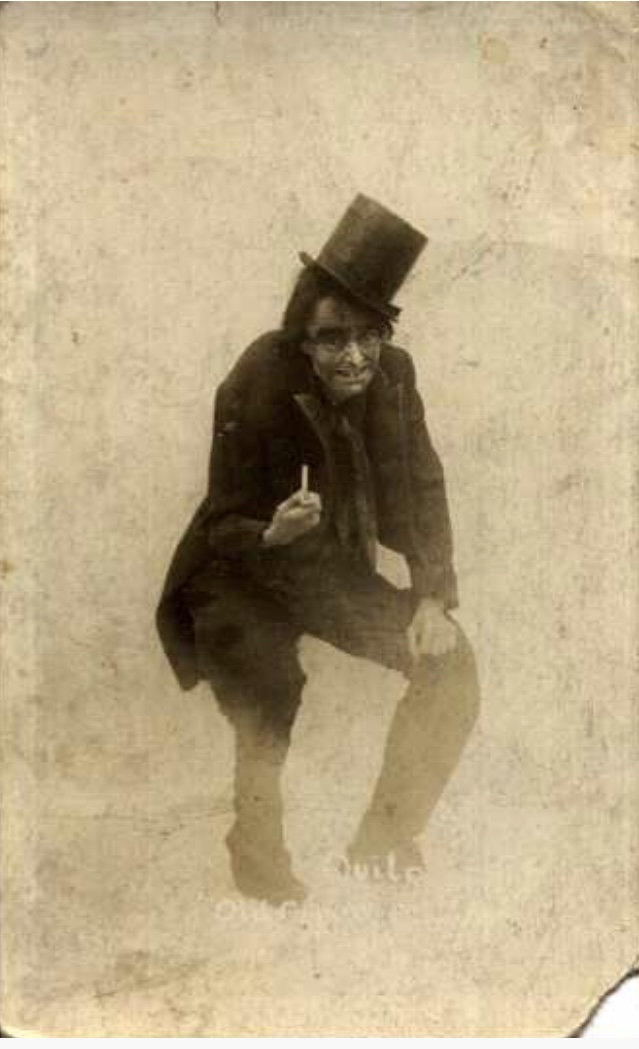
Uriah Heep

Arabella knew the importance of changing costume and make-up in the shortest possible time to keep the audience engaged. She went off stage to change her costume but applied her make-up on stage, sitting at a small table with her back to the audience, thus heightening the atmosphere and expectation. She said she prepared for her act by reading a book through twice – once to gain an idea of the story and the second time to make a study of the characters. If a character particularly appealed and she felt it would make entertaining theatre she would take a dramatic extract from the book and study it together with the character. Arabella would get ideas for costumes from descriptive passages in the books and she remarked she found Cruikshank’s drawings of Dickens’s characters invaluable.

Pete the Manxman


Facial expression was also important and she told how she often sat in front of her looking glass for hours trying to ‘set’ her face properly for a particular character. Then she would ‘make up’ the features using as few lines as possible for speed on stage. Arabella also impersonated female characters from Dickens as well as Shakespearean characters and characters from popular books of the time. Pete the Manxman was a character from a novel, The Manxman, written by Hall Caine and published in 1894. The novel used Manx dialect and Manx Gaelic words and phrases which may have attracted Arabella as it was an extra challenge. She also got the chance to play the violin. Audiences would have known the character as the book was serialised in magazines and became a bestseller.

1920

Arabella married Basil Hart Cole in 1915 and at a later date we find her working with a Basil Hart, presumably the same person. She worked through World War l but by 1920 interest in the music hall had waned and we find her diversifying into pantomime, revue and concert parties. 1920 saw Arabella in Leeds taking a leading role in Fizz, ‘the latest musical success’, with Basil Hart as business manager. In 1921 she appeared as Widow Twankey in Aladdin in Cannock with Basil Hart as the Emperor. In 1922 they were both members of The Criterions on the Britannia Pier, Yarmouth. In 1923 Arabella Allen and Basil Hart are listed as a double act at the Empire Cinema in Luton. The following week Arabella appeared at the same venue as the Dickens Girl while Basil was a singer of high class songs on the same bill. In 1926 she is listed as a member of Ronald Frankau’s ‘Cabaret Kittens’ which was billed as a comedy show at the South Parade Pier, Portsmouth.

1930

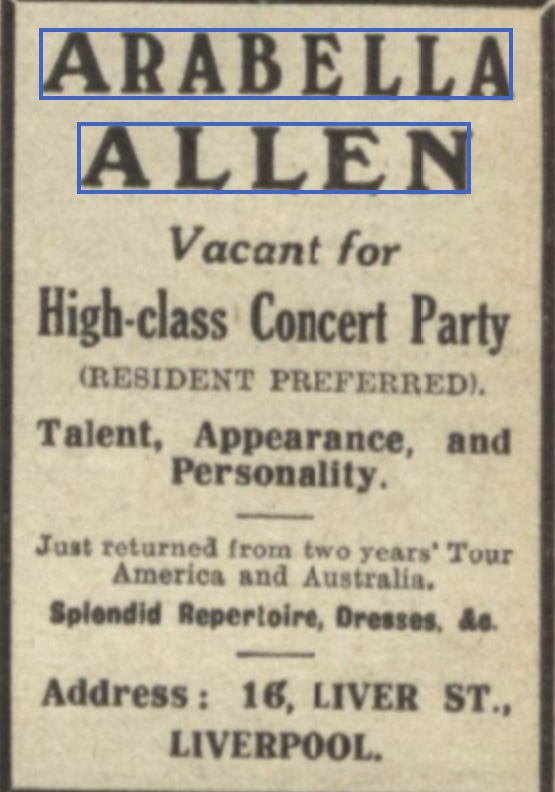
In 1930 there was an advert in the trade paper, The Stage, placed by Arabella on her return from a two year tour of America and Australia. She was looking for work but kept to her high standards. The last mention I could find about her career was an appearance at the Harbour Pavilion, Morcambe, in 1932 where she was said to ‘impersonate with reality.’

Arabella Allen died in Liverpool in 1948 at sixty-five years of age. She seems to have been a bright, versatile character, keen to uphold her respectable image and continuing to live up to her early reviews. Her impersonations ‘put her not only in the first rank of the music hall profession but stamp her as a really gifted actress.’ I was told she never appeared at the Britannia Panopticon as she was considered too high class for their usual audience. I’ve enjoyed looking into the life of this music hall performer and I sincerely hope I’ve done her justice.

Quilp
Squeers


Thanks to M @BritPanopticon for your help and kindness

@BNArchive @BritPanopticon @britishlibrary

Revill and Syd ‘still trying’

We left Revill and Syd at the beginning of the 1930s when money was tight and work was hard to come by. A note to Syd and Ethel, written by Gordon on a memo from Dale Forty Piano Merchants, regretted that business was so bad for the couple. He went on to say that the slump was general and that the workers in his company had their salaries reduced by 10%.

In 1933 Syd received a letter from Bill Hengler, another performer, asking for repayment of a loan. Hengler needed the money for a court case but stressed ‘this request would not be made if circumstances did not demand it.’ Angeline Hengler apologised in a letter the same year that Bill had not yet thanked Syd for the return of the loan but he ‘had to rush off on Monday for panto rehearsals – – a lot of waste of time.’ Galling for Syd and Ethel who were struggling to find work.

Syd wrote material for their act and amongst the papers is a rather bitter, unfinished letter, heavy with sarcasm. Written from ‘The Pier, Southend (11th week)’ to John and Bill, it begins ‘was tickled to death to get your letter from Middlesboro. Dear old Middlesboro. How I envied you and with Corn Dekker too. Dear old Corn. In fact he’s more than a corn. He’s a malicious growth.’ Corn Dekker was part of an acrobatic act with his partner, Elly Pan. The letter goes on ‘and then you motored from Middlesboro to Rhyl. Well that was nice for you.’ Was this a letter written in anger or was it used as part of the act? Corn Dekker and Elly Pan, the Well-Balanced Pair, were bottom of the bill performers but worked venues such as the Chiswick Empire and the Pavilion Liverpool while Revill and Syd were asked by Percy Hall’s Agency to pencil in Scarboro for one night. ‘As it is the off season and no visitors Jack Gillam cannot afford to pay any money.’ There was the chance to set up a seven-day engagement at the same venue, £12 top whack, if they hadn’t played the town for three years. Presumably this relied on them doing the unpaid night to show willing and there was no guarantee they would get the seven nights.

A monologue/song penned by Syd gives us an idea of how performers tried to make it in the business, moving from one type of act to another until they ran out of options. We have a singer, dancer, juggler and pickpocket, among others. In 1934 Revill and Syd’s strap line was a poignant ‘Still Trying’ while in 1936 they were Revill and Syd ‘Who just Fool Around.’ In the next decade Syd performed solo, billed as the ‘Cheery Chatterbox’ and ‘Tall and Talkative.’ He also took on the role of comedian compère at The Vic, Burnley in 1942 and in 1948 was part of a comedy team in Folkestone’s resident company,‘K’Nights of Joy.


In 1950 Syd took over the role of comedian compère at Worthing Pier Pavilion for a new Saturday Evening Party series. The local paper warned of the waning popularity of the parties and noted the tendency in Worthing to persist too long with a type of show because it was originally successful. This could not have raised Syd’s spirits and it’s the last reference to his working life I was able to trace.

Syd Revill


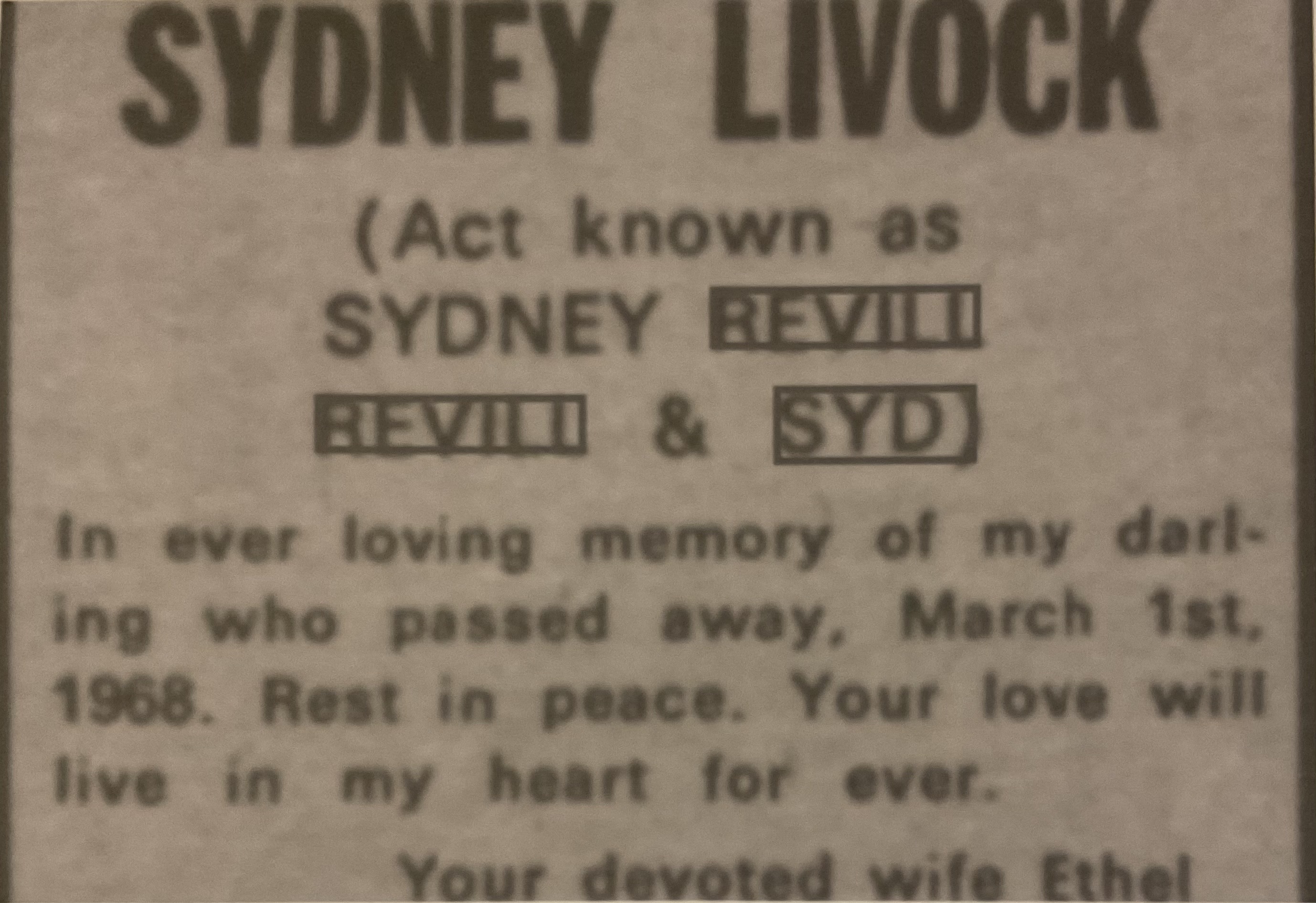
In 1969 his wife, Ethel, placed a notice in the trade paper, The Stage, in his memory. Syd and Ethel left a trace of their lives in the letters, scribbled scripts and contracts which I was lucky enough to find. Syd featured strongly in these but Ethel kept them safe. I wish I knew more about her.

Thanks to the British Newspaper Archive and the Monomania collection.

It must be true – it’s in the paper!

A chance find of a page of adverts from the Music Hall and Theatre Review made me wonder how much we could glean of the performers’ lives from the persuavise proclamations. Did they believe the claims or take them with a pinch of salt? Let’s have a look at the mundane and the magnificent.

In many of the postcards of music hall artistes they are not smiling, or they’re smiling with closed mouths as their teeth were not in a good state. Help was at hand from the People’s Teeth Association who offered single teeth and dainty teeth sets for actresses with teeth sets available from £1.


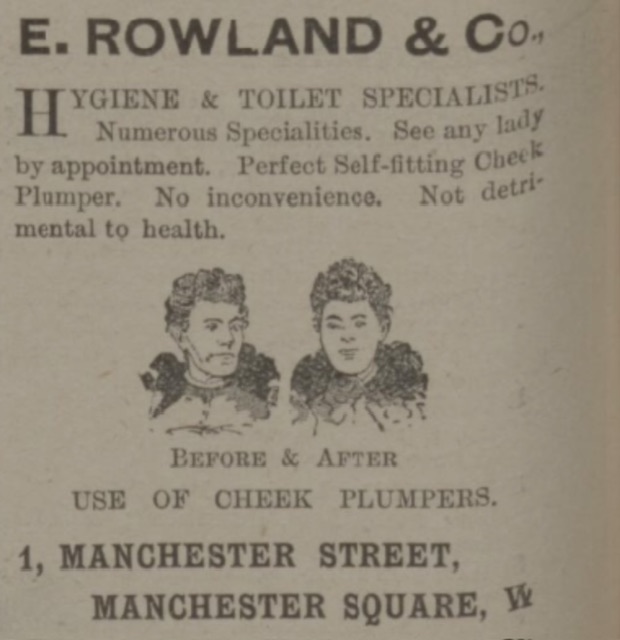
The life of the music hall performer was a wearing one, often rushing from hall to hall and travelling long distances to the next booking with costumes and props. The advertisers were keen to help them look their best, however tired, and one way to pep up their appearance was with cheek plumpers. These were supplied by E. Rowland, hygiene and toilet specialists.


There were businesses supplying wigs to the profession but it seems not all wigs were equal. A small advert placed by Bird, 8 Lower Marsh, Lambeth claimed to be the cheapest house for all kind of wigs – also selling props, vento figures and animal dresses. A rather Dickensian feel to that one. C. Holz, on the other hand, used only the very best hair for ladies wigs and stocked good burlesque wigs at moderate prices. Here is Miss Fossett, burlesque actress.

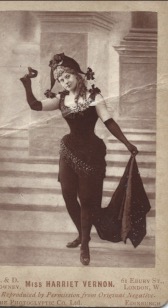
W. Clarkson, who seems to have been the champion wig maker, boasted of being a ‘Wig-Maker of all the Principal Ladies and Gentlemen in the Profession and Costumier to Misses Harriet Vernon, Vesta Tilley, Marie Lloyd and others.’ The Arthur Lloyd site has some interesting information on the man and his business. http://www.arthurlloyd.co.uk/Backstage/ClarksonWigs.htm


H.& M. Rayne supplied a large range of theatrical goods including costumes, tights, boots, shoes and symmetricals. Symmetricals were padded tights to give the wearer shapely hips and calves and a more voluptuous figure. Performers who could not afford Rayne’s symmetricals could make their own from cotton wool and a pair of tights. Kitty Lord, eccentric English singer, is almost certainly wearing symmetricals in this photo. For the less adventurous, Reid’s sold best worsted tights at seven shillings a pair or three pairs for twenty shillings.

Songwriters advertised their skills, often in a rather terse manner as we can see from Frank Leo’s advertisement.

My favourite advert is for a complete Pierrot costume available from Gamages. Based on the wistful figure of Pierrot from pantomime, these more robust entertainers appeared over many years in concert parties, on beach stages and at the end of the pier. All male troupes gave way to mixed groups of men and women wearing the conical hat and white top and trousers decorated with black pom-poms. Here are Catlin’s Scarborough Pierrots.

There are many more adverts for boarding houses (good cooking), photographic studios (with style and distinction) and tricycles (extreme comfort, no vibration) giving us an insight into the performers who scoured the pages to improve their working lives.

Thanks to the British Newspaper Archive, Arthur Lloyd, Monomania collection.


All Change

A chance purchase of a postcard drew me into the intense world of the quick change artist, popular in music hall and theatre at the beginning of the twentieth century. Audiences loved the performers who would take on many characters changing costume, usually behind a screen, time after time in just a few seconds. One such was Fatima Miris, real name Maria Frassinesi, from Bologna in Italy who was inspired by Leopoldo Fregoli an admired quick change artist and singer. In 1907 she came to the attention of Oswald Stoll, music hall owner extraordinaire, and was engaged to appear at the London Hippodrome straight from her success in Bologna. She presented the Marchioness Divina at the Hippodrome acting seven different characters of various ages, never being off-stage for more than five seconds. There is much farcical content with characters hiding in cupboards, mistaken identities and finally pistol shots and a chase in which all the characters run through the room in rapid succession. The chase was so fast that the audience could believe they were seeing several figures at once. There is an excellent video on YouTube showing Fatima Miris in action posted by albarnardon.

In Bologna the artiste had produced The Geisha, performing fifteen parts and changing costume 175 times over three hours. She could sing soprano, alto, tenor and baritone. In fact, she was so skilled that rumours began to circulate that she used a double in the act. The management of the Hippodrome took this as a slight on their reputation and offered a reward of £1000 to anyone who could prove a double was used. The reward was never claimed. She toured for some years, taking in North and South America, Australia, New Zealand and Egypt before retiring in the mid 1920s. However in 1932 Fatima Miris embarked on a final farewell tour and returned to South America where the public had never forgotten her.

Also around 1907 there was a young Italian quick change artist, said to be twelve years of age and calling herself Fregolina, billed as The Miniature Fregoli. The reporter for John Bull found ‘the juvenile prodigy, as a rule – – a burden grievous to be borne’ but that Fregolina was an exception – indeed a genius. Her quick changes of costume included the characters of policeman, French comedienne, Italian peasant girl, priest and a musical clown. She also portrayed composers such as Liszt, Wagner and Verdi conducting the resident orchestra with much energy and using much facial expression, being recalled again and again.

Our third quick change artiste, Madame Fregolia (that name again) appeared in Ireland and England a little later, mainly between 1912 and 1914. She was Austrian and the Daily Express described her as one of those high class turns from the Continental variety stage going on to say this exceedingly clever turn must be seen to be thoroughly appreciated. Having survived railway collisions, fire and flood in her travels Madame Fregolia took audiences by storm with her rapid changes of costume. During her act she showed a film taken behind the scenes giving away the secrets of her lightning changes. She opened the act with double-voiced singing, moving on to her fifty or so quick changes in hour, employing a complete change of character for each. On receiving a standing ovation at the Royalty Theatre Madame Fregolia took a series of quick curtain calls making a lightning change between each to appear in different Court dress. In an interview in 1914 Fregolia, who was appearing in Dublin, said she was delighted by her reception and that she found Irish audiences more responsive and more lively than the English while French and Italian audiences were too lively for her taste. Perhaps a risky comment in a newspaper interview.

Thanks to British newspaper archive.co.uk, Monomania Collection, albarnardon

.

A Good Night Out

Music hall audiences had a reputation for rowdiness, often well deserved, as they didn’t attempt to hold back their feelings about an artiste. However this was mild compared to theatre in the Georgian period when the gentry would invade the stage during a performance causing the actors the indignity of elbowing their way to the front to say their lines. Spitting, bottle and orange peel throwing and sword-fighting were also audience pursuits, while the singing of popular songs competed with the thespians speaking from the stage. There was a fashion for the wealthier patrons to use their footman to save a seat, which meant the servant could be sitting next to ‘a lady of the first quality’ – just not done.

In the earlier part of the nineteenth century Song and Supper rooms in public houses, known as Free and Easies, were a form of popular entertainment. Entry was free but the audience were expected, nay encouraged, to buy alcoholic drink. Originally only men were admitted and the entertainment came from within the audience with amateur singers strutting their stuff. A reporter tells us ‘the entertainment given at these pothouses are of a low order. Songs are badly sung, mumbled or bawled with an earsplitting accent.’ This didn’t put off the punters and gradually landlords added rooms for the entertainment nights which could be two or three times a week. The Free and Easies developed a reputation for drunkeness and bad behaviour. A letter to the Fleetwood Chronlcle in 1876 tells of the writer passing a Free and Easy in Blackpool ’out of which four boys were coming, and into which two were going; one of them was smoking a short pipe and the others were using profane language; the ages of these boys were from twelve and fourteen years.’ In the same year the chief constable of Preston described a Saturday night where five to six hundred young persons, half of them apparently under the age of sixteen, were to be found in a Free and Easy. Women and girls were now enjoying this kind of entertainment and young women would often take their babies. Groups of women, unaccompanied by men, were common with work-mates and neighbours meeting up for a good night out. The Manchester Evening News in 1877 reported the Chief Constable of that area proposed there should be Free and Easies without intoxicating drinks but which instead would sell cocoa. This seemed doomed to failure.

Wilton’s Music Hall 1859

As the popularity of this form of entertainment grew the halls increased in size and professional acts were engaged. In the early halls the audience sat around tables, some facing away from the stage, and food and drink were served by waiters. There was much coming and going and the performer, without the luxury of a microphone, would battle to be heard above the general hubbub. Gradually music halls were built as separate buildings with audiences sitting in rows on various levels with bars for the the purchase of drinks. The main bar of the Metropolitan, Edgware, had a wide glass panel through which the entertainment could be viewed. The top tier, the gallery, was usually the rowdiest with the ’gallery boys’ hurling rotten fruit and veg, dead cats and even iron rivets at the stage to show their displeasure. The orchestra pit was often covered in wire netting to protect the musicians. The music hall managers were constantly engaged in trying to make their halls respectable with licence renewal a major worry. A contract from the Parthenon Music Hall Liverpool, signed by Adelaide and Oswald Stoll, contains the rule ’Every artiste must stringently avoid introducing any obscene Song, Saying or Gesture’. They were up against such reformers as Mrs Ormiston Chant who saw the halls as dens of depravity with predatory prostitutes and crude performers from whom the lower classes needed protection.

Marie Lloyd

In 1909 the unfortunate Miss Charlesworth appeared at the Islington Hippodrome (later Collins), the Canterbury and the Paragon. On each occasion a gentleman introduced her and took a long time over it, to the displeasure of the audience. When Miss Charlesworth finally appeared she was greeted with a cacophany of boos and hisses and declared herself too nervous to to sing. She bowed to the audience before leaving the stage to the sound of sarcastic laughter. Fortunately this was not the experience of all music hall performers although their reception could vary from hall to hall. Marie Lloyd, much loved in London, was given an unenthusiastic reception in Bradford but gave as good as she got by not responding to an encore at the finish. TS Eliot noted that he had seen Nellie Wallace ’interrupted by jeering or hostile comment from a boxful of East-enders’ but he had never known Marie Lloyd to be confronted by hostility. He also notes that Nellie Wallace made a quick retort that silenced her hecklers.

Vesta Tilley
Ada Reeve

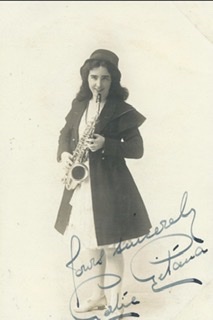
When postcards became the rage in the early 1900s music hall artistes were well represented and their fans collected the cards and sent them with messages of their everyday lives. In 1906 Mrs Baldwin hopes to see Vesta Tilley a week on Monday while a couple of years earlier Miss Gordon looked forward to seeing ’this Lady’ in all her latest successes. Ted saw Vesta Tilley at the Hippodrome (postmark blurred) and sends a card saying ’this girl was one of the soldiers who sang some songs.’ Ada Reeve is described as a nice girl – ‘not half’ by THH when writing to Miss Caley in 1905 and Florrie writes to Ethel to say she went to the Palace in Hull and bought the postcard of Gertie Gitana, ’the star artist.’ These audiences probably restrained themselves from throwing rotten food at the stage but showed their feelings nevertheless by joining in with chorus songs, wild applause and a bit of heckling. They had their favourites and sang and whistled their songs as they went about their business, secure in the feeling they had found a place where they belonged.

Thanks to the British Newspaper Archive, The Victorian Music Hall – Dagmar Kift

Marie Lloyd and Music Hall – Daniel Farson, Marie Lloyd – Richard Anthony Baker

The Popularity of Music Hall website

Gertie Gitana

A market for vice and drinking

Mrs Ormiston Chant

In late Victorian times music halls were a countrywide institution and had moved on from grimy rooms at the back of public houses to full blown palaces of entertainment with elaborate architecture and lavish interiors. However, they still had their critics with the foremost among them being Mrs Ormiston Chant of the Purity Party whose view was that the halls catered for people who had a small proportion of brains. She began a campaign to remove the much appreciated Ladies of the Promenade from the Empire, Leicester Square, in London. This did not please a young Winston Churchill who wrote in his autobiography we were scandalised by Mrs Chant’s charges and insinuations. Churchill was filled with scorn when a canvas screen was put up to hide the exquisitely dressed prostitutes and was part of a crowd who later tore it down. The council closed the bars and the canvas screen was replaced by railings but the decision was reversed at the next licensing session and the discreet ladies returned. Marie Lloyd fell foul of the prudes on the prowl at the Empire when Mrs Ormiston Chant made a public protest by shouting out during one of her songs. Even the Empire’s footmen in blue and gold livery could not convince the purity campaigner that this was a respectable house.


Perhaps unsurprisingly, Marie Lloyd received a less than flattering description from Virginia Woolf after a visit to the Bedford Music Hall in Camden Town. We went to the Bedford Music Hall last night and saw Miss Marie Lloyd, a mass of corruption – long front teeth – a crapulous way of saying desire and yet a born artist – – A roar of laughter went up when she talked of her marriage. She is beaten nightly by her husband. This was at the music hall built in 1899 on the site of the original Bedford Music Hall (1861). The original being later known as the Old Bedford and providing the setting for a series of Sickert’s music hall paintings.

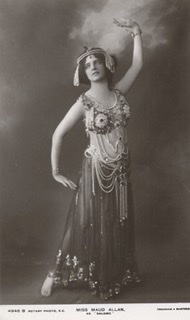
The dancer, Maud Allan, caused a stir in 1908 with her classical dancing and costume particularly when performing Salome which was banned from some music halls and theatres. The Palace, Manchester, received a visit from the Chief Constable who watched her performance and advised the Manchester Watch Committee to prohibit her appearance. He expressed a wish to go on the stage to get a closer look at her costume but was denied this by the managing director, Mr Alfred Butt. The Chief Constable was very anxious to accept Mr Butt’s suggestion that he look at the costume when Miss Allan had changed but was stopped by the official who was with him. Maud Allan agreed in some cases to dispense with the carrying of St John the Baptist’s head on a platter during her performance. I was amused to see that on one occasion she was followed on the bill by Juliette’s Sea-Lions.

America was not without it’s perils for the music hall star as male impersonator, Bessie Bonehill, found out during a season at Tony Pastor’s theatre in New York. She kept an anonymous note she received which quoted a passage from the scriptures, The woman shall not wear that which pertaineth unto a man, for all that do so are an abomination. Bessie Bonehill had short hair, unusual for the time, and did not wear wigs unlike many male impersonators. The Daughters of America tried to have her expelled from the country but she was enormously popular.

Thanks to British Newspaper Archive, Marie Lloyd and Music Hall by Daniel Farson, Marie Lloyd Queen of the Music Halls by Richard Anthony Baker, England’s Gem – the story of Bessie Bonehill by Richard Bonehill


The Latest Scourge

The latest scourge – a term used to describe the flu pandemic of 1918/19 when the country was already reeling from the devastating effects of the First World War. Theatres and music halls were a welcome escape for many of the population and the authorities saw them as a morale booster in difficult times. There was much debate as to whether music halls should remain open and which, if any, preventative measures should be taken. Local authorities took their own decisions. By October 1918 no regulations had been issued in Oxford as to the closing of places of amusement, even though influenza was rife. Audiences declined considerably and the military authorities placed music halls out of bounds for infantry cadets, although Royal Air Force cadets could still attend. In contrast, at the beginning of November 1918 the licensing committee in Birkenhead issued regulations covering the opening of music halls. The first performance was to take place between 6.30 and 8pm with the premises thoroughly ventilated until 8.45pm when the second performance began. Children under fourteen were not to be admitted under any circumstances and overcrowding should be avoided. Scrupulous cleanliness was expected.

In many areas the military of all ranks were forbidden to attend the halls which had a severe effect on their takings and led to calls for restrictions to be eased. Various medical experts shared their opinion that it was useless to close places of amusement while allowing travel on omnibuses and trains. Oswald Stoll, music hall manager, declared that the epidemic was much more likely the result of a diet lacking in fats and sugar than visits to the music hall. The London Palladium installed an ozone ventilating system and sprayed a strong germ killer all over the theatre between each performance. The Illustrated London News suggested there was no better preventative than a good sneezing fit once or twice a day and various manufacturers talked up the efficacy of their products.


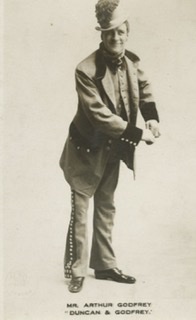
Despite some measures to combat the virus it dealt a blow to performers as well as audiences with popular artists unable to perform. The trade papers sought to play down the seriousness of the outbreak but were reporting many stand-ins for advertised artists. Daisy Jerome, irreverent mimic and singer, cancelled her appearance at the Palladium after succumbing to influenza while coster act, Duncan and Godfrey, appeared at the Holborn Empire still suffering from the after effects of the illness. Anthony Burgess, the writer, tells us of his mother’s death from influenza in 1918 when he was two years old. He talks about her life in music halls and her marriage to his father, a pianist in the pit orchestra. I can find no other evidence of Elizabeth Burgess/Wilson appearing on the halls and would be grateful for any information.

Elizabeth Burgess Wilson

Music halls were perhaps more fortunate here than in the States, Canada and Australia where the halls closed for weeks at a time inflicting severe hardship on performers and venues. In her autobiography, Take it for a Fact, Ada Reeve talks of being hospitalised with flu in South Africa with theatres closed and the public warned not to go to places of amusement. All in all, many parallels with the current pandemic and then, as now the fervent wish was to get back to normal.

Ada Reeve


Thanks to British Newspaper Archive, thestage.co.uk, Take it for a Fact – Ada Reeve
Photograph of Elizabeth Burgess/Wilson reproduced with kind permission of the International Anthony Burgess Foundation


I’m an old hand at love

0FD29E9F-BBD6-42EC-A545-1BD413C1468AMinnie Cunningham was a music hall singer and dancer, best remembered for featuring in a painting by Walter Sickert. She was born in Birmingham in 1870, the daughter of music hall comic singer Ned Cunningham. He was well-loved and successful, being described by the Birmingham Gazette as the ‘greatest comic singer in the world.’ His daughter started her music hall career after his death when she was ten years old. Minnie Cunningham tells us she began as a male impersonator and sang her father’s songs, although reviews of the time don’t mention male impersonation, only her singing and dancing. She moved from the provincial halls to London where she performed at the principal halls of the day.

It was during her London success that Minnie Cunningham was introduced to the 31A333B7-D7C4-4610-B0B0-EAC59D94897Epainter Walter Sickert by the poet and music hall critic Arthur Symons. Both men were smitten by the popular artiste and Sickert arranged to paint her portrait. The figure of Minnie Cunningham was painted from life in Sickert’s studio in Chelsea in 1892. For this painting she stood on a raised stand as if she were on stage but when asking her to pose for a later painting Sickert writes that he had built a proper stage  ‘six foot square, with steps up to it.’ The background is thought to be the Tivoli on the Strand in London where Sickert had seen her perform. The painting was originally entitled, Miss Minnie Cunningham ‘I’m an old hand at love, though I’m young in years.’ This was one of her popular songs at the time and while singing it she dressed as a young girl which made the performance more daring. The painting became known as Minnie Cunningham at the Old Bedford. It was exhibited for the first time at the New English Art Club in 1892 to a mixed reception, with a reviewer in the Pall Mall Gazette writing ‘The red dress of Minnie Cunningham glows with refined richness in its setting, but the proportions of the figure and the feet and hands seem altogether absurd.’ The subject and setting were just too shocking for many at the time and it was said by some to represent degradation and vulgarity.

Minnie Cunningham remained popular for some years, performing, writing songs for herself and others and appearing in pantomime. She maintained it was very difficult to gauge the public taste in choosing a song but her compositions ‘The hen that cackles the most’ and ‘Give us a wag of your tail, old dog’ seem to have hit the mark. Minnie spent time in Ireland, calling herself ‘the Little Irish Gem’ and a tale is told of male admirers turning up with glass bottles to throw at the performer who replaced her at the top of the bill, giving us an idea of her popularity.

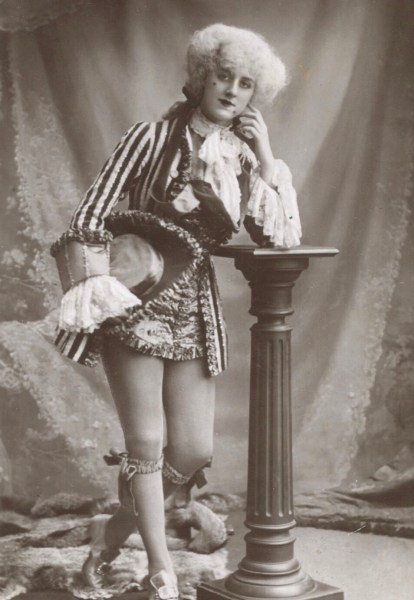
While in Ireland she claimed £500 through a court case for alleged breach of 9D63B80C-0979-452C-A9E1-EBFD29E749B3contract in which she was engaged as principal girl in the Jack and Jill pantomime at £30 a week. She refused to wear the costume for her part saying it was too short and offended her standards of decency. Discussions with management were unsuccessful, often ending in tears. Eventually another performer, Edith Fink, was appointed to the role and had no complaints about the length of the costume. At one point in the court proceedings the two performers removed their hats and boots and stood back to back on a table to see who was the taller of the two. Minnie Cunningham was undoubtedly the taller and was asked to put on the costume for the jury’s eyes only. There were rumours that she was worried that Dorothy Ward playing the part of Jack, an extremely well-known and talented performer, would outshine her. The jury could not agree on a verdict and were discharged.
53156582-82D5-4CA2-AD2E-7C908FC11B21

Dorothy Ward

Minnie Cunningham lived with her mother in Southgate Road, Hackney. Her mother died in 1916 and Minnie seems to have retired shortly after this. She died in 1954 at the age of eighty-four and her later life is a mystery. She remained in Southgate Road, but her obituary tells us only of Minnie’s performing life taken from her own words.


Thanks to britishnewspaperarchive.co.uk
                   monomania postcards (@monomaniablogs)
                   Walter Richard Sickert & the Theatre 1880-1940. PhD thesis submitted    University of St Andrews by William Rough 2010


The Mysterious Relative

436C4841-8B4A-4425-BBF2-893287C07448

This photo is signed Marie Levison and is of the relative of a friend. Information is hard to come by and it seems Marie may have been the person in the family that no one talked about. Was she considered beyond the pale for embracing the theatrical life? We don’t know but would love to find out. The photo shows her as Dandini in the pantomime Cinderella at the Theatre Royal, Cardiff in January 1888. Marie Levison was not her real name, which could have been Kate Lee, and she changed her name again to Kate Toole in October 1888. It wasn’t unusual for performers to change their names if they took on a new act or hoped to leave an unsuccessful career behind, but why did she do it?

We know that Marie Levison had been with the D’Oyley Carte Company for some years and then switched to music hall. We don’t know why she did this. As Kate Toole she appeared on various bills and seems to have been well received although never appearing as the star turn. She was represented by Hugh J Didcott who was one of the leading agents of the time. Didcott had a dispute with the leading music halls which he lost and many of the music hall stars left his agency which meant he was left with the less popular artistes. When did he represent Kate? Did she stay with him? We don’t know the date of her birth but sadly we know how she died. The Brighton Gazette reported in March 1903 that Kate Toole was found dead in bed by her landlady. The cause of death was given as alcohol poisoning.

If anyone has any more information on Marie/Kate it would be wonderful if you could share it and I’ll pass it on to the friend with the mysterious relative.


Thanks to the British Newspaper Archive and the British Music Hall Society.