
The general population in the early 1900s was as susceptible to fashion and new-fangled ideas as we are today. The craze for roller-skating came over from America and swept the country. As ever, the music hall reflected life in the outside world and took the opportunity to bring new delights to its audiences. Roller-skating acts were soon included in music hall programmes and managers were encouraged to update the halls with flooring to accommodate skaters, or rinkers as they were known. As seen below, the suggestion seems to be that rinkers could use the halls for skating between performances and managers could cash in at the same time.

Specialist roller-skating rinks opened all over the country for the general public but were not universally popular among those already providing other forms of entertainment. In some areas publicans organised an anti-rinking campaign and billiard saloon owners met to discuss the way to combat the attraction of roller-skating. The trade paper, The Era, tells us that music halls seemed not to suffer a decline in trade and the manager of a large venue declared that skaters liked a quiet seat at an entertainment at least one evening a week. This may have been wishful thinking as Mr Alfred Graham, proprietor of the Hull Hippodrome and Middlesbrough’s Oxford Music Hall, was declared insolvent and blamed skating rinks for his troubles.
Health benefits were said to be gained from roller-skating with even the most  delicate people finding it beneficial. Headaches would become a thing of the past as the blood coursed more vigorously through the veins. Little is said about falls and broken limbs. Seeing the experts performing at rinks and music halls increased the popularity of the pastime with participants attempting dance steps and couple dancing, with mixed results.
 Dolly Mitchell was a young Scottish roller-skater who teamed up with her American teacher, Harley Davidson, to give displays in rinks and music halls. Advertised as the greatest skaters in the world and giving a wonderful exhibition of trick, fancy, acrobatic, graceful and artistic skating. They displayed over £1,000 worth of gold and diamond medals won in competition. When appearing in Scarborough they cake-walked, two-stepped and waltzed on roller-skates before executing a perfect ballet dance. Harley Davidson described Dolly Mitchell as being sixteen years old, the daughter of a doctor in Aberdeen and the granddaughter of ‘old John Begg’ a whisky distiller. They visited London to have a portable maple floor made to fit any stage at a cost of £140 and Harley boasted they would be ‘the first roller-skating dancers and poseurs to travel with such a flooring’.
Rosey Anslow and Ella Grahame were working in Poland 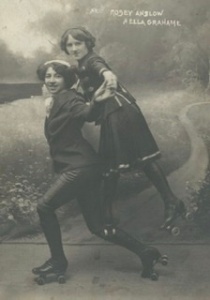 and had this publicity photo taken by Léo Forbert’s studio in Warsaw. Ella writes on the back of the card ‘What price this for swank. Do you like me in pants? The people can’t get past the size of my bottom here’. Let’s hope the audience appreciated their skill as well.
Information worth sharing is that Mr H. W. Izod, manager of a roller-skating rink in Earls Court London had, on two occasions, entered a wild beasts’ cage in public. The first time he played a game of ping-pong in the presence of eleven lions and the second time he shaved another man with fifteen lions around him. He was said to be a sworn enemy of monotony.
The rinking craze was short-lived and by 1911 many rinks had closed with investors losing considerable sums of money. However the music hall soldiered on.


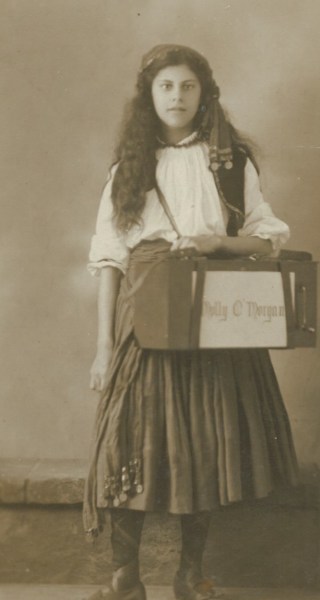 with a barrel organ. The card on the barrel organ reads ‘Molly O’Morgan’. The young woman is staring out from the photograph as if she has a story to tell. There is a story of Molly O’Morgan, the daughter of an Irish mother and an Italian organ-grinder father, who had dark brown hair and laughing eyes. It is said her mother died when Molly was young and she and her father left Ireland with a barrel organ and monkey to take their chances in Europe. Molly would dance while her father played the barrel organ and the crowds were charmed into parting with their coins. They travelled from city to city and eventually arrived in Monte Carlo where Molly’s fortunes changed. She was noticed by Duke Medici-Sinelli, an elderly widower, who naturally enough was also rich and charming. The Duke arranged for Molly to appear at a theatre and in the way of fairy tales she immediately became a star. Molly and the Duke married and unkind rumours suggested she was a gold-digger although the couple seemed devoted to each other. When the Duke died Molly did not marry again but came to Monte Carlo every year and stayed in the same suite in which she and the Duke had spent their honeymoon. She was said to live in Hungary with a distant branch of the Duke’s family.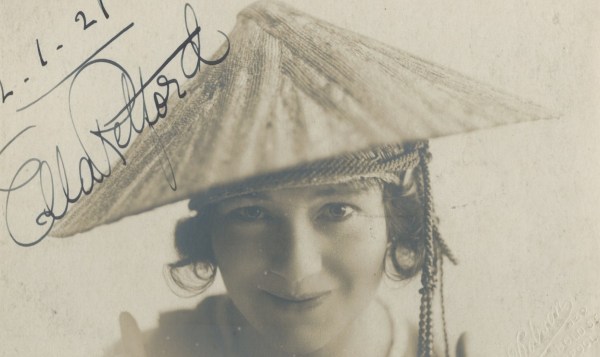

 ‘I was extraordinarily pretty’ states Caroline Otero in her autobiography My Story and this much is true. Music hall singer and dancer, courtesan and gambler, La Belle Otero lived a life of extremes and exaggerations that would raise eyebrows today. She claimed her mother was a beautiful Andalusian gypsy, Carmen, who danced, sang and told fortunes. Such was her beauty that a group of passers-by including a young Greek army officer, gazed at her in admiration as she was engaged in the unromantic task of hanging out the washing. The autobiography makes much of the courtship and devotion of the young man and tells of his death in a duel with Carmen’s lover. It is more likely La Belle Otero was born into a poor family in Galicia in November 1868 and given the name Augustina although she adopted the name Caroline at a young age. As a child she was sent away to work as a servant and is said to have been raped at the age of ten. It’s no wonder she gave herself a more romantic beginning.
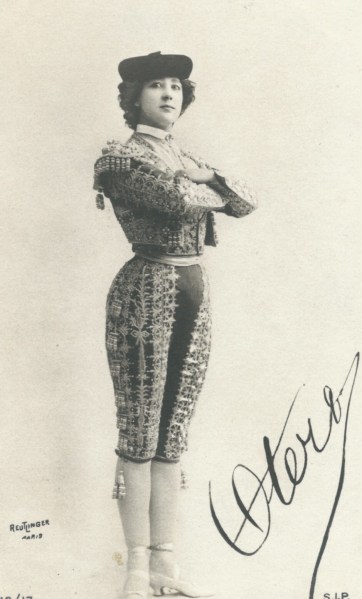 who found her work as a dancer in a Café. She moved up the scale from theatre to theatre, starring at the Folies Bergère , collecting and discarding admirers and lovers. It is said men fought duels over her and left themselves penniless after showering the object of their affection with flowers and jewels. A writer in The Sketch in 1898 reports that Mdlle Otero came on to the Alhambra stage in a salmon-pink dress covered in diamonds and turquoises with her fingers heavy with rings, the dress setting off her pale complexion and black hair to great advantage. The diamonds, worth millions of francs, were tokens of the esteem in which she was held by her admirers. The writer goes on to say that ‘most performers humbly seek the suffrages of their audience; La Belle Otero, whose equipment is in many respects inferior, from the artistic point of view, to that of her competitors, demands them as a right.’
 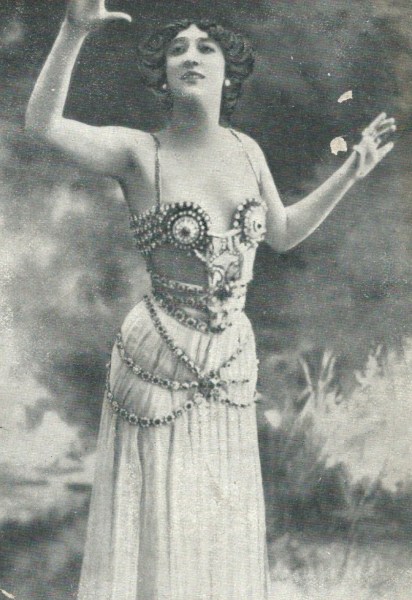 Otero was adept at self publicity and in 1902 the Paris correspondent of the Express writes that an engineer in Brussels was constructing an airship for her ‘by means of which she hopes to make a triumphal entry next August into Biarritz.’ She was worried it could be dangerous and so the balloon was to be dragged along by a car attached by a thin wire. If there was an accident she could ‘descend to the car by means of a rope ladder, which she will have tied in to the airship. The airship will float gracefully above the automobile at a height of 100ft.’ Mistress to ambassadors, princes, including the future Edward VII, and nobility throughout Europe, La Belle Otero scandalised and fascinated society in equal measure. Her weakness was gambling and she lost vast sums of money at the tables, sometimes her own and often her admirers’ fortunes. The Tatler tells us that in 1909 police raided a gambling club in Paris and found fifty women and ten men. On further investigation another woman, Caroline Otero, was found in a cupboard.
 Into the Limelight