
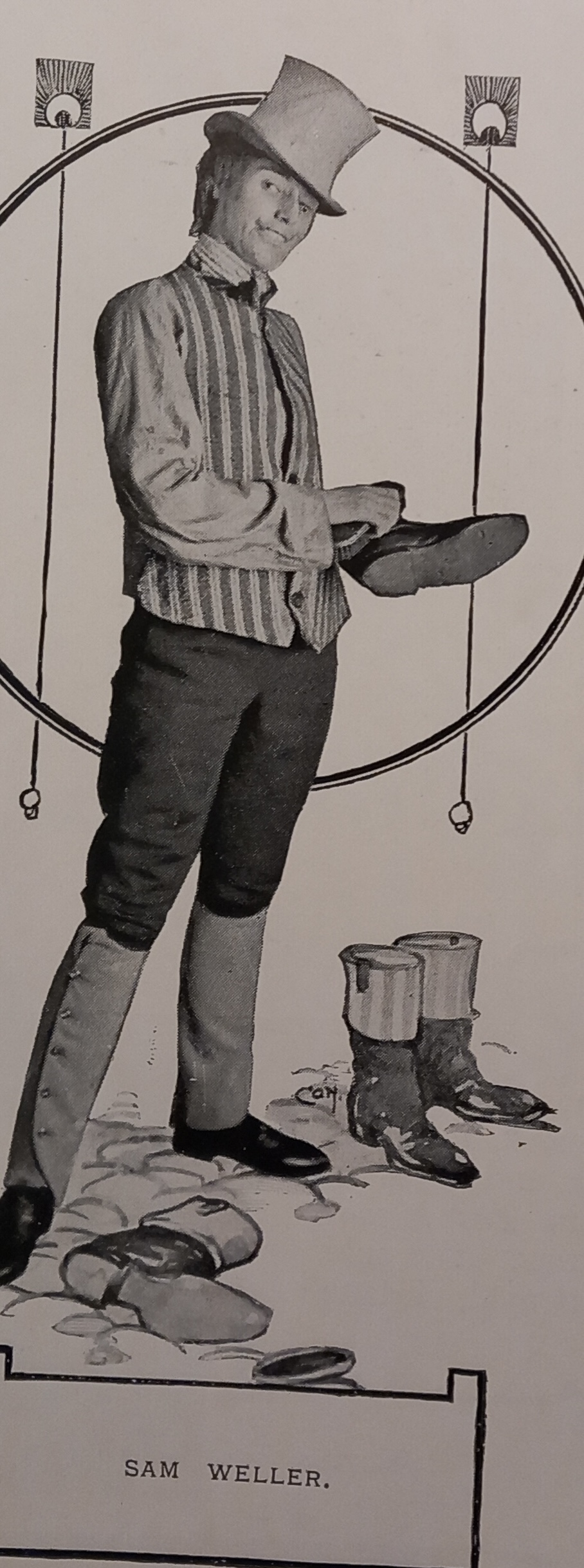
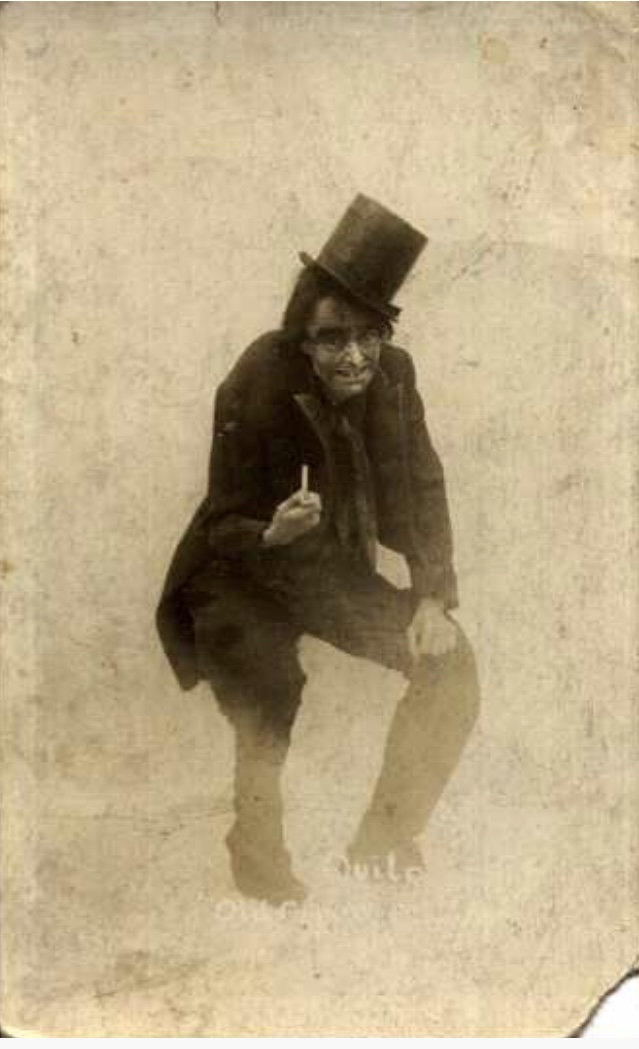
During a visit to the Britannia Panopticon in Glasgow, the oldest music hall in the world, I was introduced to someone from the hall who very kindly shared the story of a member of her family who had been a music hall performer. Later she sent me pictures of the artiste in costume and these had such personality and presence that I was intrigued and wanted to write a blog about her.
Margaret Esther Clarkson was born in Liverpool in 1883. There are two dates given for her birth, 20th January and 22nd April. The earlier date is probably accurate as she was baptised on 18th February 1883 at St Thomas, Liverpool. By her own account she was an avid reader and re-reader of the works of Charles Dickens while growing up. He was so famous he would still have been in the minds of the public although he died in 1870. Margaret enjoyed mimicry and impersonation, moving from amusing her brothers and sisters to entertaining at amateur concerts. She gave impersonations of Shakespearean characters, recited monologues and played the violin. According to an interview in Cassells Magazine from July 1906 Margaret’s friends ‘were continually advising my parents to place me on the music-hall stage.’ She went on to say her parents were prejudiced against music halls and hesitated to encourage their daughter to become a professional performer on the halls. They did not want her to endure the precarious life of thousands of music hall artistes and ‘practically stipulated’ she should be a success from the start. Luckily, it seems she was.
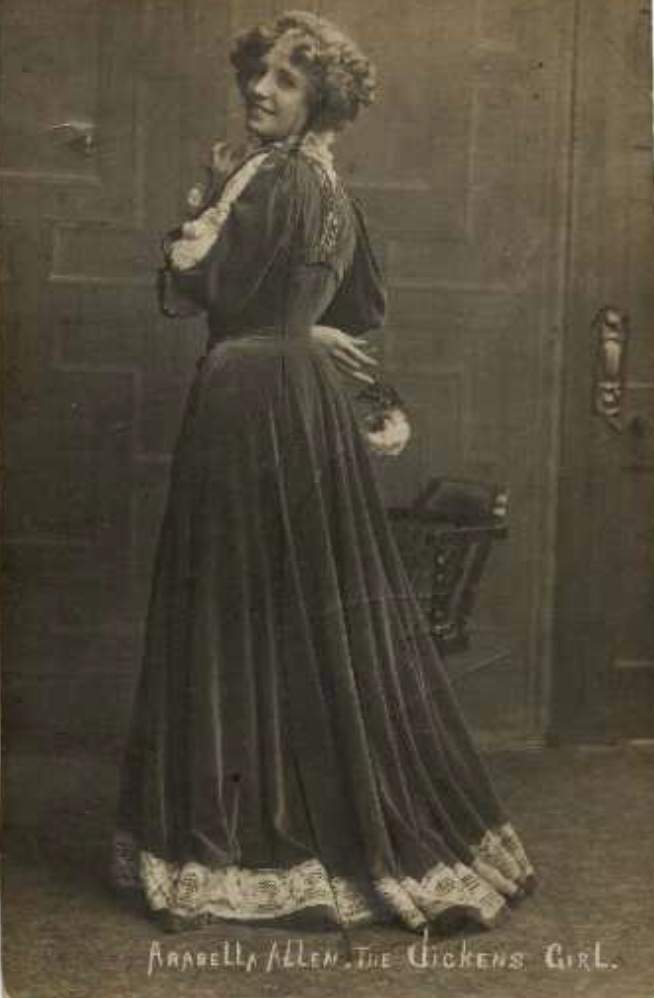
Margaret’s fondness for Dickens was put to good use as it was decided she should try some of Dickens’s male characters who would be reasonably well known. It also meant she wouldn’t be seen as a low entertainer, but rather a refined one. She used the stage name Arabella Allen, who was a character from The Pickwick Papers, and called herself ‘The Dickens Girl.’ Bransby Williams, a popular stage performer, had made a name for himself in the halls depicting characters from Dickens and Shakespeare before Arabella Allen appeared on the scene. I’ve been unable to find any reference to his opinion of this young rival. She received glowing reviews which mention her intelligence and engaging personality.

Arabella Allen started to be mentioned in the trade papers in 1904 with The Sketch featuring a page of photos from her act at the London Pavilion. She seems to have caught the eye of magazine editors and in July 1906 Cassells magazine included a long interview with Arabella entitled Marvels in Make-up. The magazine’s editor called it a very curious and remarkable article. He pointed out that ‘several other stories and articles will be found in our issue, but I have ventured to select a few outstanding features so that our readers may realise, that every month we are making special efforts to maintain the reputation of Cassells Magazine for lively, interesting and entertaining matter.’ The magazine had articles, short stories and serialisation of novels which would mainly appeal to men so this seemed a departure from the norm and rather daring. Arabella Allen was obviously a big hit in the music hall but still respectable enough to be interviewed.

Arabella knew the importance of changing costume and make-up in the shortest possible time to keep the audience engaged. She went off stage to change her costume but applied her make-up on stage, sitting at a small table with her back to the audience, thus heightening the atmosphere and expectation. She said she prepared for her act by reading a book through twice – once to gain an idea of the story and the second time to make a study of the characters. If a character particularly appealed and she felt it would make entertaining theatre she would take a dramatic extract from the book and study it together with the character. Arabella would get ideas for costumes from descriptive passages in the books and she remarked she found Cruikshank’s drawings of Dickens’s characters invaluable.

Facial expression was also important and she told how she often sat in front of her looking glass for hours trying to ‘set’ her face properly for a particular character. Then she would ‘make up’ the features using as few lines as possible for speed on stage. Arabella also impersonated female characters from Dickens as well as Shakespearean characters and characters from popular books of the time. Pete the Manxman was a character from a novel, The Manxman, written by Hall Caine and published in 1894. The novel used Manx dialect and Manx Gaelic words and phrases which may have attracted Arabella as it was an extra challenge. She also got the chance to play the violin. Audiences would have known the character as the book was serialised in magazines and became a bestseller.
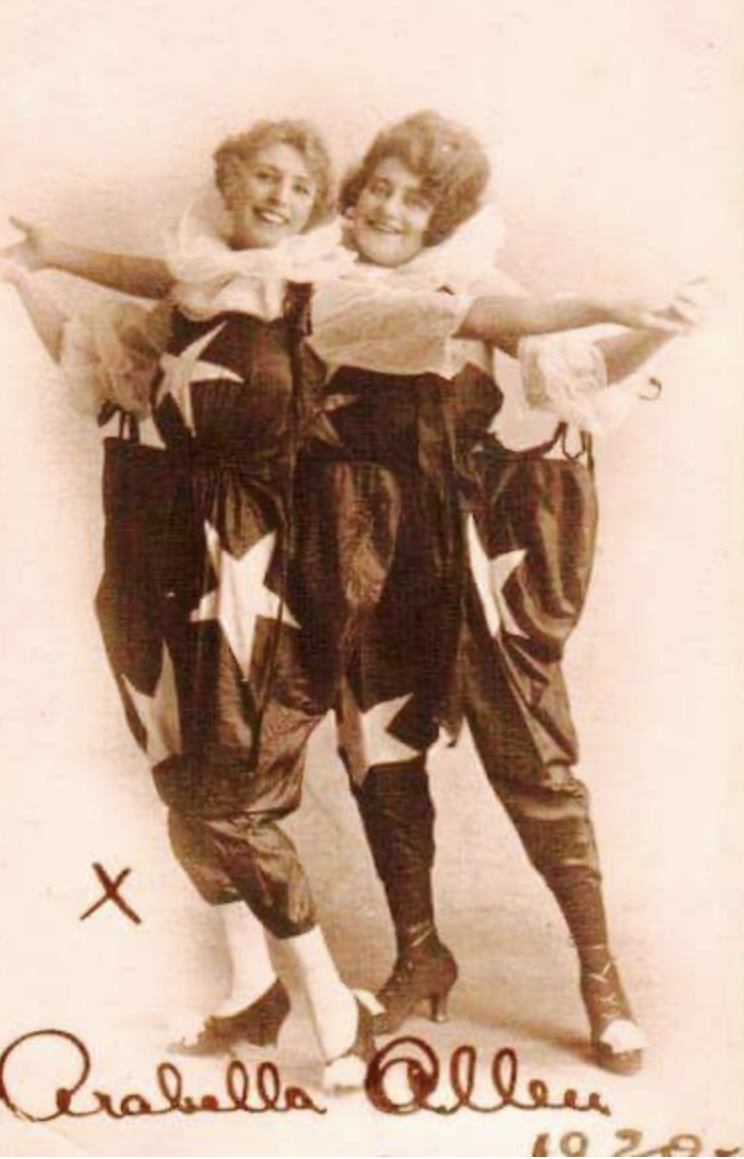
Arabella married Basil Hart Cole in 1915 and at a later date we find her working with a Basil Hart, presumably the same person. She worked through World War l but by 1920 interest in the music hall had waned and we find her diversifying into pantomime, revue and concert parties. 1920 saw Arabella in Leeds taking a leading role in Fizz, ‘the latest musical success’, with Basil Hart as business manager. In 1921 she appeared as Widow Twankey in Aladdin in Cannock with Basil Hart as the Emperor. In 1922 they were both members of The Criterions on the Britannia Pier, Yarmouth. In 1923 Arabella Allen and Basil Hart are listed as a double act at the Empire Cinema in Luton. The following week Arabella appeared at the same venue as the Dickens Girl while Basil was a singer of high class songs on the same bill. In 1926 she is listed as a member of Ronald Frankau’s ‘Cabaret Kittens’ which was billed as a comedy show at the South Parade Pier, Portsmouth.
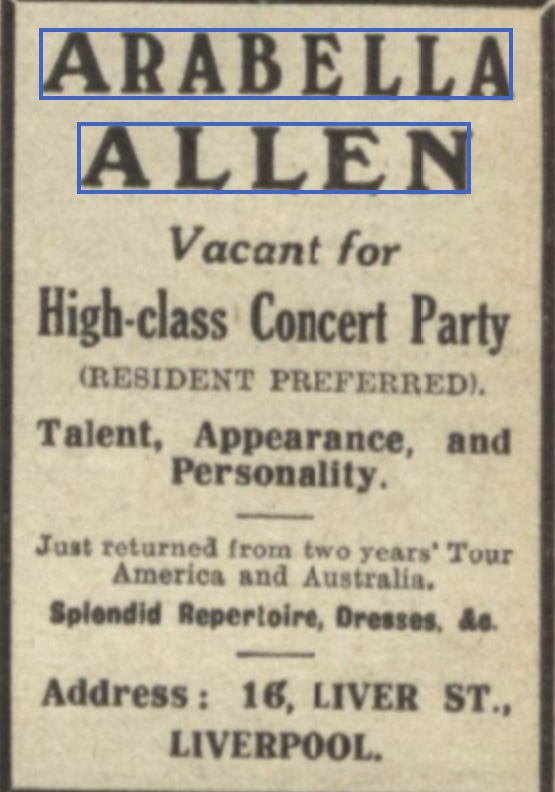
In 1930 there was an advert in the trade paper, The Stage, placed by Arabella on her return from a two year tour of America and Australia. She was looking for work but kept to her high standards. The last mention I could find about her career was an appearance at the Harbour Pavilion, Morcambe, in 1932 where she was said to ‘impersonate with reality.’
Arabella Allen died in Liverpool in 1948 at sixty-five years of age. She seems to have been a bright, versatile character, keen to uphold her respectable image and continuing to live up to her early reviews. Her impersonations ‘put her not only in the first rank of the music hall profession but stamp her as a really gifted actress.’ I was told she never appeared at the Britannia Panopticon as she was considered too high class for their usual audience. I’ve enjoyed looking into the life of this music hall performer and I sincerely hope I’ve done her justice.

Thanks to M @BritPanopticon for your help and kindness
@BNArchive @BritPanopticon @britishlibrary
 Into the Limelight