A delve into the postcard collection comes up with some images and captions worth sharing. Hundreds and hundreds of women tried their luck on the music hall stage, living in cheap boarding houses as they crisis-crossed the country hoping for fame and fortune. Some scratched a living, some achieved greatness, but many sank into lives of poverty and squalor. The following are a mixed bunch of performers of whom some are traceable for a good number of years while others tried to find their way with no mention in the publications of the time.
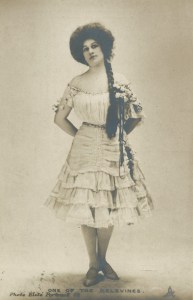
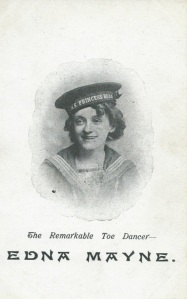 Edna Mayne is described as the Rembarkable Toe Dancer and in January 1911 we find her at the Palace Theatre, Gloucester, in Puss in Boots. She is described as an exceedingly clever sand dancer while her work on her toes was said to be very smart. A sand dance has been described as an eccentric dance with exaggerated movements while dressed in an approximation of Egyptian style.
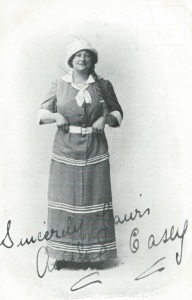
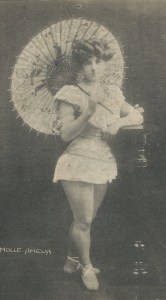
Annie Casey is variously described as a comedienne, serio and dancer. The first listing I can find for her is 1896 and by 1904 she was doing well enough to put a notice in the trade paper, The Era. She tells us she has no vacancies in 1904 and 1905 but five weeks vacant in 1906. Reports of her become scarce after 1909 although in 1911 she is on the bill at the North Seaton Hippodrome as a vocalist and chorus singer. In 1913 a notice in The Era placed by the MHARA (Music Hall Artistes’ Railway Association) asks for information on the addresses of various performers, including Annie Casey. The MHARA negotiated reduced fares on the railway for its members. I’ve seen a postcard of Will and Annie Casey but can’t find evidence of them performing together. She had a brother called Will, this information coming from their mother’s obituary which was placed in a trade paper.
Update 27/8/23 – I’m extremely grateful to Annie Casey’s grandson, Mike Casey, who has contacted me about Annie Casey. I said above that Will was her brother but he was, in fact, her husband. Apologies to all, and especially members of their family, for that mistake. I was confused at the original time of writing as there seemed to be conflicting information available. Mike has kindly sent me interesting information about his grandparents and I’m pleased to put the record straight. There is so much interesting information that I’m going to make it the subject of my next blog with huge thanks to Mike Casey.
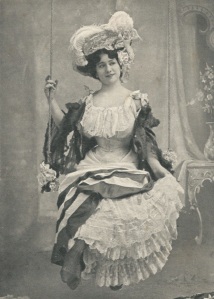
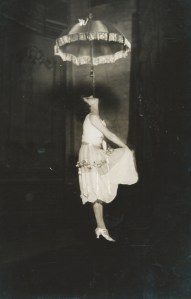
According to her postcard Miss Etta performed a disrobing act on the trapeze. From the trade paper of the time, The Entr’acte, dated March 21st 1903 we learn she was due at the Alhambra on the following Monday evening. Ten years later, in 1913, there is a reference in The Era to Mlle Yetta whose act is on a high wire. ‘She disrobes, picks up a handkerchief, gives a very clever dance—a splendid turn this.’ There is a reference to Miss Etta in an American publication so she may have been from the States. More research!
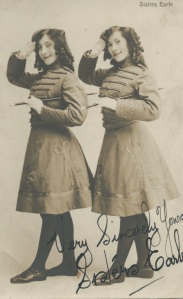
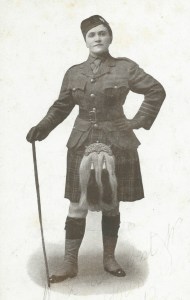
Lastly, the Sisters Earle, of whom I can find no trace other than the photograph they left behind. They look like real sisters and greet us cheerily with a salute. If anyone can come up with information about these two performers, or any of the others mentioned in this post, I’d love to receive it.
UPDATE!
The great-nephew of the Sisters Earle has contacted me to say that they were Florrie and Harriet Warsaw from a family of performers. Their brothers were Ernie and Dave, who performed as the Warsaw Brothers and their younger sister Doris was a pianist who performed as Doris Crawford. Around 1901 they were living in Broken Hill, Australia but were living in London by 1911. Thank you so much for the information, Mike.
A FURTHER UPDATE
More information has emerged about the Sisters Earle. Mike, who has kindly kept me up to date with his research, met descendants of their brother, Reggie Warsaw. Reggie became part of the act, the Warsaw Brothers, after his brother David died in the flu epidemic in 1919. He then had to give up performing as he lost his hearing after diving head first into a water barrel. After finding more photos of the Sisters Earle, Mike is now sure they were not of Florrie and Harriet, but of his own grandmother Doris, the youngest child, and her sister Gladys. He has found photos of them in the Far East and more photos of them performing. What a fascinating family! Thanks very much for passing on the new info. Much appreciated.
Thanks to the British Newspaper Archive, Mike Pailthorpe, Monomania Collection

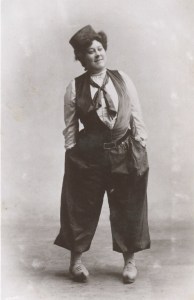
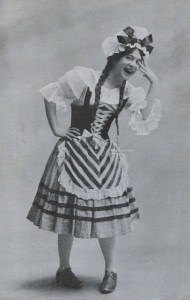


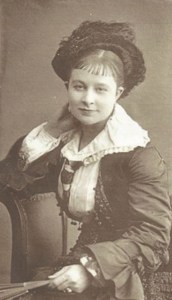


 Daisy Jerome was born in the States in 1888 but moved to England as a child when her father suffered a financial crisis. Money was needed and she followed her sister on to the stage. She was a small, dainty figure with bright red hair, compelling eyes and an expressive face. Her appearance belied her risqué performances and her hoarse, sensual voice. She was a toe-dancer and a wooden shoe dancer, but best known as a mimic and comic singer. Daisy married Frederick Fowler in 1906 but they lived together for less than a year with Fowler blaming the marriage breakdown on the constant presence of his mother-in-law. He filed for divorce on the grounds of Daisy’s misconduct. She was living with Mr Cecil Allen in Battersea by this time and claimed Allen would marry her if she was divorced. The decree nisi was granted with Fowler saying he would shoot Allen if he didn’t marry Daisy. She left for a three year tour of Australia shortly after accompanied only by her mother. She adopted the name ‘the electric spark‘ and seems to have lived up to this in her public and private life.


 Adelaide Gray came to this country from Australia with her son, Oswald, after the death of her husband. She married John Stoll who was the owner of the Parthenon Rooms in Liverpool and took over the venue shortly after John’s death in 1880. The Parthenon Music Hall was born. Adelaide was helped by fourteen year old Oswald who looked after the artistes backstage, eventually putting together the programme and booking the acts.
 The contract I have is for two artistes and the weekly salary is four pounds ten shillings between them so any fine would severely damage them financially. The contract is signed by Adelaide and Oswald Stoll.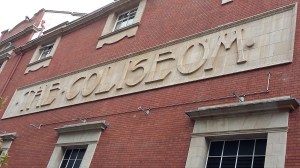



 Into the Limelight